
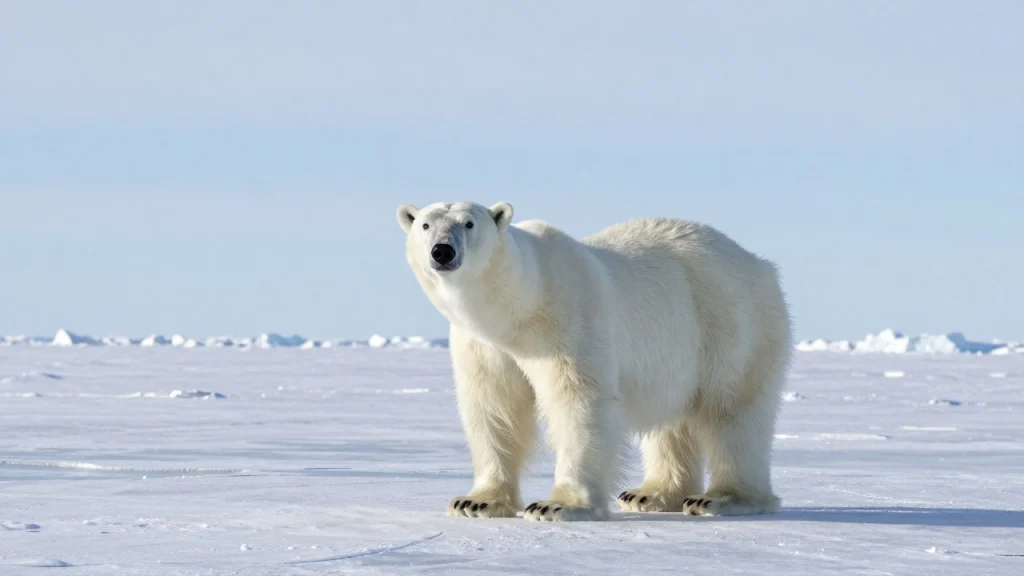
The frosty silhouette of a polar bear navigating the Arctic wilderness presents one of the most recognizable sights on the planet, yet its snowy color is actually an elaborate optical illusion. Underneath this pale exterior, the animal has dark black skin, while each individual strand of fur is completely transparent and free of biological pigment. Although the massive predator appears solid white from a distance, microscopic inspection reveals that every guard hair is a colorless, hollow tube containing an air core.
This hollow architecture dictates how natural sunlight interacts with the bear. The striking pale coloration occurs because ambient light bends and refracts through these transparent structural tubes. Because the coat is translucent, it scatters and reflects visible light. Having dark skin helps the animal absorb heat from solar rays, while the white-looking coat repels external moisture and provides effective camouflage across ice fields.
The optical physics of colorless hair
Polar bear fur contains no melanin pigments to produce brown, red, or black hues. Each shaft functions like an uncolored glass tube.
Dual-layer insulation and heat preservation
Surviving in extreme subzero environments requires extraordinary thermal defenses. The coat consists of elongated outer guard hairs that clump together in water to shield an underlying layer of dense, plush underfur. Directly against the hide, this tightly packed underfur provides deep thermal insulation against freezing Arctic temperatures.
The guard hairs also provide essential physical protection against dampness and sea spray. Once the animal climbs back onto dry land, excess water readily rolls off the slippery guard hairs. Beneath the hide lies an insulating layer of subcutaneous fat measuring from 2 to 4 inches, or 5 to 10 centimeters, in total thickness.
Why polar bears appear yellow or cream
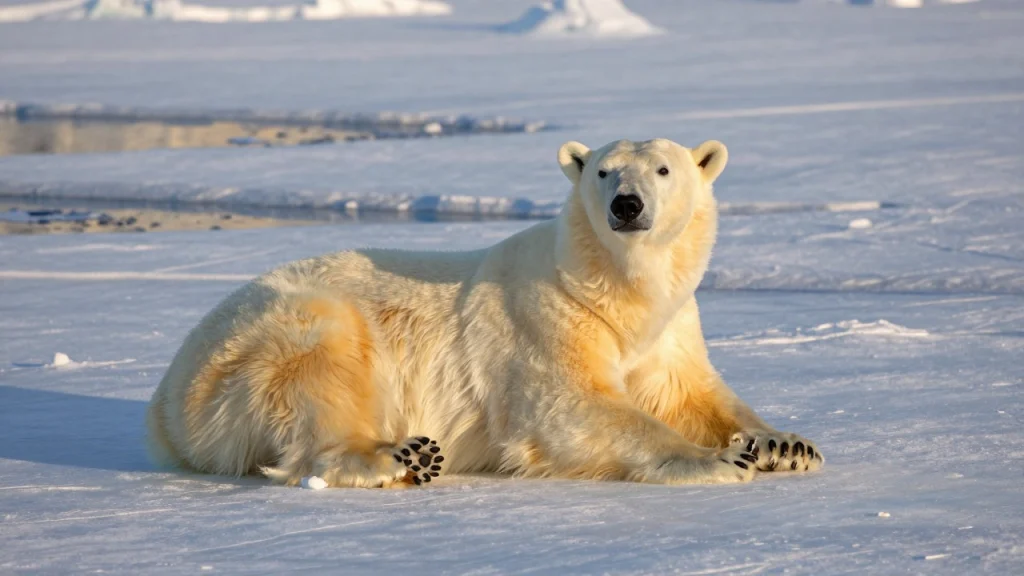
While polar bears are famously described as white, their pelage frequently exhibits noticeable color variations. Sunlight oxidation, natural dietary oils, and lingering prey debris frequently tint the outer coat a distinct yellow or cream shade. In summer months, sun exposure oxidizes the coat, deepening the yellow tint. Depending on shifting seasonal light and atmospheric conditions, the coat can also show faint brown or gray tones.
Cleanliness plays a central role in maintaining the coat’s insulating efficiency and appearance:
- To keep their pelage clean and remove debris, the animals deliberately roll in fresh snowbanks.
- Following a substantial meal, bears routinely wash their coats by licking their paws and rinsing themselves.
Maintaining a clean coat is a matter of life and death in polar latitudes. Petroleum exposure degrades the thermal protection of the coat, forcing the mammal to expend greater metabolic energy while posing serious poisoning hazards.
Traction and movement across slippery ice
Navigating treacherous pack ice requires specialized anatomical modifications on the feet:
- Coarse bristles covering the bottom of each paw prevent the heavy carnivore from slipping on slick surfaces.
- This sole fur dampens the sound of footsteps when the hunter sneaks up on resting prey.
- In the sea, the massive front feet act as swimming paddles while the trailing rear legs stay flattened like a rudder.
A transparent third eyelid shields the eyes during severe blizzards and aids vision while diving. Submerged bears can spot swimming prey at distances of up to 15 feet (4.6 meters).
Stalking Arctic seals across the pack ice
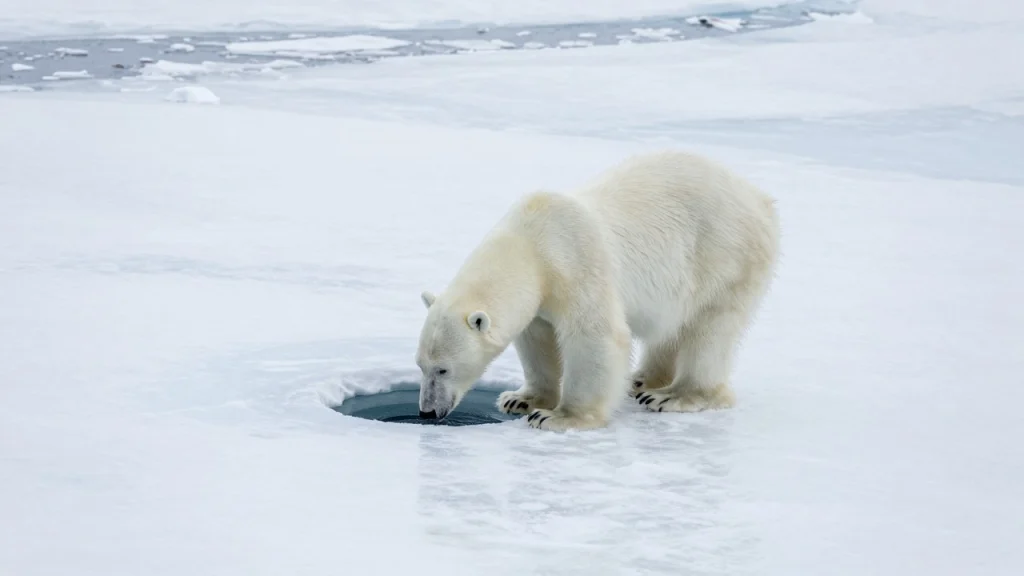
Camouflage provided by the white-looking fur is indispensable for hunting. The bear’s keen sense of smell can detect an air hole across distances up to 1 mile (or 1.6 kilometers) and track a seal on pack ice 20 miles (32 kilometers) away. Once a productive opening in the ice is located, the predator relies on extreme patience. During still hunts, a bear can stay entirely motionless beside a frozen vent for multiple hours.
Because ringed seals are the most abundant pinnipeds throughout the polar north, they constitute the carnivore’s primary food source. Capturing a single ringed seal supplies sufficient caloric energy to sustain a mature bear for 11 days.
Evolution, growth, and maternal care
The species bears the scientific name Ursus maritimus, meaning sea bear in recognition of its marine lifestyle. Known as nanuq in the Inupiaq language, this Arctic predator shares close evolutionary ties with terrestrial brown bears. Evolutionary biologists estimate that the lineage split from ancestral brown bears roughly 200,000 years ago. Over these millennia, the species developed its colorless fur and dense blubber.
Growth and sexual dimorphism are pronounced in polar bears:
- Reaching body lengths of up to 3 metres, they rank as the largest extant bear species and terrestrial carnivore.
- Large adult males can attain body masses of up to 800kg, easily doubling the physical bulk of females.
Unlike other temperate ursids, polar bears do not enter true winter hibernation, with only expectant females sheltering in maternal dens. Newborn young enter the world hairless, blind, and weighing just over a pound (0.5 kilograms). Lactating females produce milk containing 36 percent fat, which represents the highest lipid content among all ursids.
Conserving the Arctic’s greatest predator
Modern census estimates indicate that approximately 26,000 polar bears survive across circumpolar ranges. Curtailing global atmospheric warming and protecting pristine pack ice habitats remain critical priorities for securing their long-term survival.