
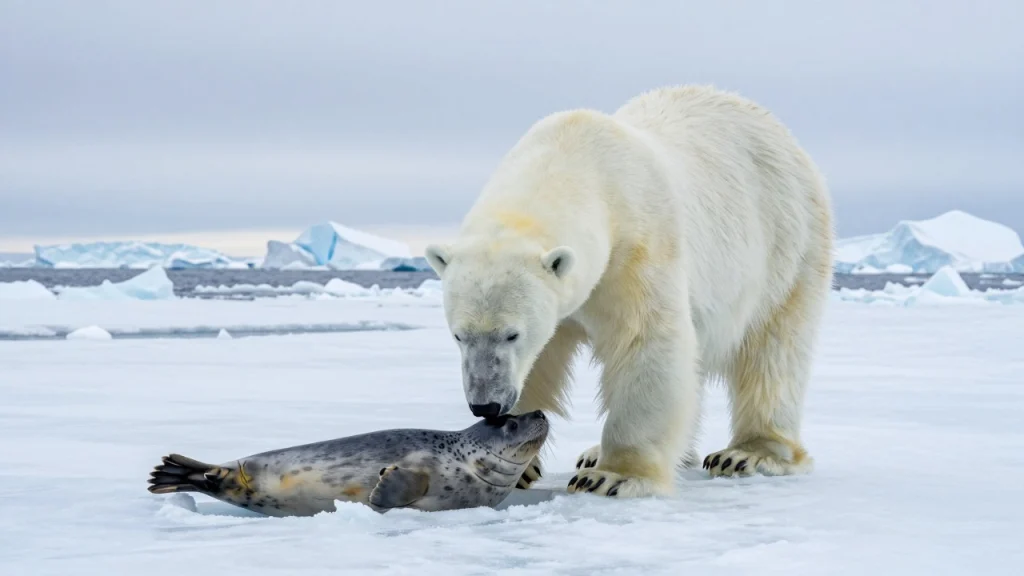
Yes, polar bears do eat fish, but only occasionally, and never as the mainstay of the diet. One inventory of the species’ food places fish in the same category as sea birds, small mammals and carrion, which is to say the things a bear picks up rather than the things it hunts. Nearly all of the calories come from seals.
The reason is physiological. A polar bear runs on fat. It carries four inches of blubber under its skin for insulation, and the calorie density of seal blubber is what stocks that layer and carries the animal through the months when hunting stops. Food that does not fill the fat bank can plug a gap in a lean season, but it cannot be the reason the animal is built the way it is.
Seals, not fish, carry the whole diet
Polar bears are the most carnivorous members of the bear family, more so than brown and black bears. Wherever sea ice is available they concentrate on ringed seals, taking bearded seals and other marine mammals only now and then. Across most of the Arctic, ringed seal by itself accounts for over half of the prey taken.
Harp and hooded seals also feature, along with whale carcasses scavenged from the ice. If that prey is missing, the documented fallbacks widen to vegetation, birds, their eggs and small mammals.
What the tissue chemistry says
Fatty acid analysis of Southern Beaufort Sea bears, which reads chemical traces out of stored fat, put ringed seal as the predominant prey species at 46.4 ± 1.8% of intake. Bearded seal came next at 19.6 ± 2.0%, then seabird at 17.0 ± 1.2% and bowhead whale at 15.0 ± 1.4%, with hardly any beluga whale at 2.0 ± 0.5%. Those were already bears ranging onto land more than in the past, and even in that group the seals took the lion’s share.
Patience instead of pursuit
The signature technique is ambush at a breathing hole: the bear locates a hole in the ice and waits, motionless, for the seal to surface and make the kill. That patience pays off in the calendar rather than in the moment, because a bear spends most of its time inactive, roughly two thirds of every day sleeping, lying or simply waiting to hunt.
Once a kill is secured, the bear takes skin and blubber first and leaves most of the meat behind. Unlike other bears, it does not store or cache the surplus. The body follows the same logic: teeth and jaws are shaped for flesh rather than for bone or tough plant material, and a single feeding session can involve more than 70 kg of food.
When fish actually turns up
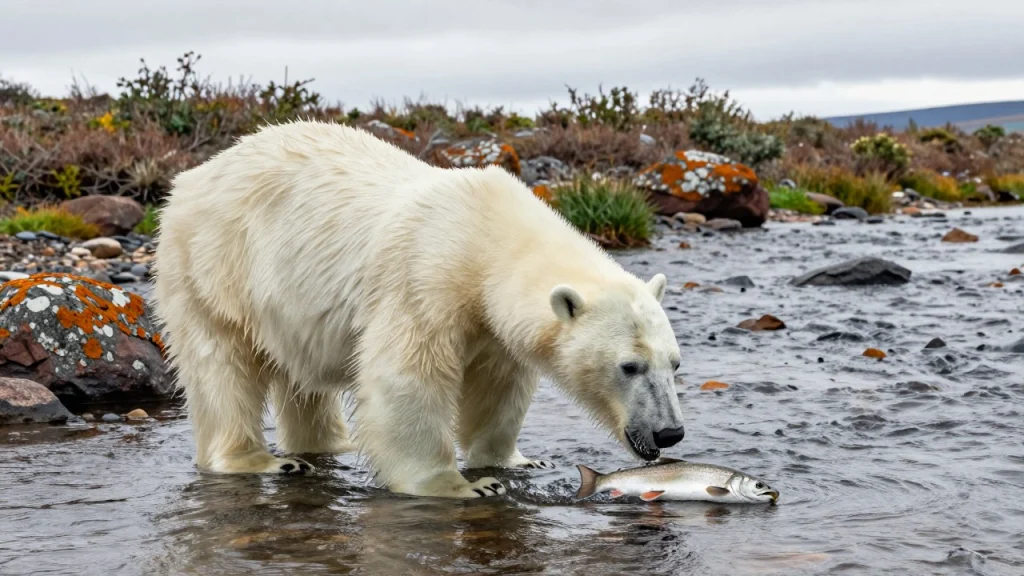
The evidence for fish eating is specific rather than general. Observers in Nunavut have recorded bears fishing for Arctic charr and fourhorn sculpin, and National Park Service guidance for Alaska describes hungry bears taking small rodents and fish, or gathering berries. Both records point to the same trigger, which is a shortfall and not a preference.
Scat analysis sharpens the picture. In western Hudson Bay, a review of land-based feeding listed fish among the foods reported for the ice-free period, alongside marine algae, grasses and berries, yet that same review found fish in very low frequencies, grouped with items such as marine invertebrates, lichens and sedges. Fish is on the record at roughly the level of an incidental mouthful.
Two conditions make it more likely. The first is timing, because a number of polar bears keep eating through the ice-free period, when seals are out of reach and the bear is standing on tundra instead. The alternatives on offer then are land plants, lichen, seaweed and kelp, small mammals, birds, berries and eggs. The second is place: bears that already use land heavily, such as those in the Southern Beaufort Sea subpopulation, are the ones most likely to be recorded trying something new.
A bear built to coast, not to graze
This is why the question of fish matters less than the question of fasting. The bulk of the reserve is laid down in late spring and early summer, and a bear can then endure long periods without feeding, metabolising the reserve while it waits for ice to return. Winter dens are the extreme version of the same idea, and among polar bears only pregnant females make them, on the sea ice, where hunting stays possible.
That reserve is what makes short stretches of hunger survivable, and it depends entirely on access to fat. A bear with a full reserve can wait out a bad season; a bear that has to live off whatever the shoreline offers is already outside the plan.
Why the answer is changing
In the Beaufort Sea subpopulation, the share of animals using onshore habitat has increased, and foraging on land-based resources such as whale remains and nesting seabirds has followed. A polar bear diet is not a fixed template but a set of habits that adjust to whatever is nearby.
What has not adjusted is the dependence on fat. On land, no other carnivore reaches the polar bear’s size, and its physiology is tuned to a single prey base. The species is currently listed as vulnerable on the IUCN Red List, with between 22,000 and 31,000 animals left in the wild, and the region is heating up at close to four times the pace of the planet as a whole. As seals grow harder to reach, the alternatives that used to be incidental, fish among them, are the ones most likely to be tried. They will not replace blubber. They are already part of the record.
A few figures worth keeping
- Adult males usually weigh 350-600kg and females 150-290kg, a range that swings through the year as fat is gained and spent.
- Adults are 1-1.5m at the shoulder, and a male on its hind legs can top 3m.
- Wild individuals are thought to reach 25 to 30 years of age.
- Strong swimmers, adults can cross from one ice floe to another in several hours of swimming, and they can detect prey up to 32km away.
- The Latin name means ‘sea bear’, which fits an animal that spends its life hunting on the ice rather than on land.
Sources
- Animal Diversity Web: Ursus maritimus (polar bear) | INFORMATION | Animal Diversity Web
- WWF: Polar bear | WWF
- San Diego Zoo Wildlife Alliance: Diet & Feeding – Polar Bear (Ursus maritimus) Fact Sheet
- U.S. National Park Service: Polar Bear – Bering Land Bridge National Preserve
- USGS Publications Warehouse (Ecology and Evolution): Fatty acid-based diet estimates suggest ringed seal remain the main prey of southern Beaufort Sea polar bears despite recent use of onshore food resources
- Polar Biology via PubMed Central: What to eat now? Shifts in polar bear diet during the ice-free season in western Hudson Bay