
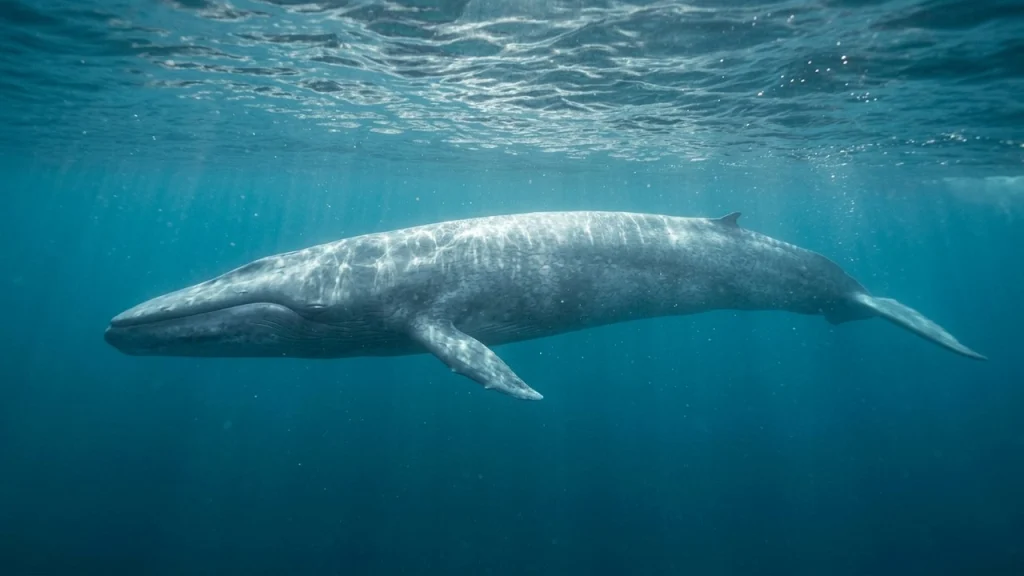
Whalers killed an estimated 350,000 blue whales during the 20th century after mechanical innovations between 1860 and 1920 enabled boats to chase them, according to Animal Diversity Web. The species headcount across the globe now constitutes merely a tiny fraction of its pre-whaling abundance because industrial fleets intensely diminished stocks in the early 1900s, although numbers are currently climbing worldwide. NOAA Fisheries states that “the primary threats blue whales currently face are vessel strikes and entanglements in fishing gear.”
Within United States conservation law, the blue whale maintains a depleted listing under the Marine Mammal Protection Act. The management agency outlines that its recovery blueprint seeks ultimately to restore the population, having an interim milestone of reclassifying the animal from endangered to threatened status. According to NOAA Fisheries, sexual maturity is thought to occur between 5 and 15 years of age, and calving intervals average an estimated 2 to 3 years.
Commercial whaling history and legal protections
Animal Diversity Web notes that their large size, fast speed, and remote habitat initially kept blue whales off the list of most heavily hunted species. Animal Diversity Web notes that blue whales were on the verge of extinction by the 1960s. Whaling operations opposed conservation restrictions, but formal protections took effect after the 1965/66 whaling season.
NOAA Fisheries reports that keeping in place the 1986 international ban against commercial harpooning serves as a core policy within the recovery plan updated in 2020.
Vessel strikes and collision hazards
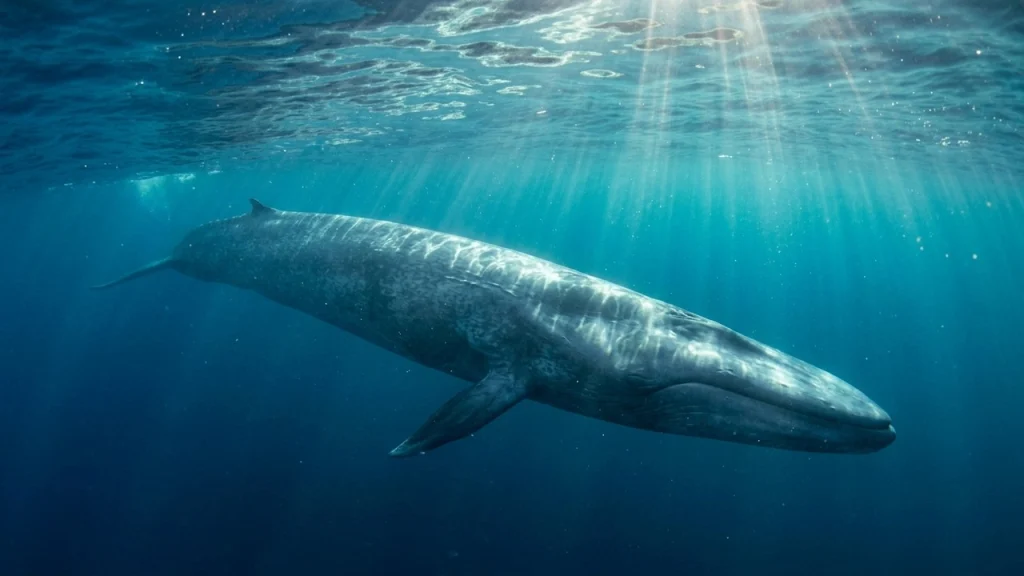
Collisions with watercraft occur throughout the marine territories that the species inhabits, with heightened danger occurring inside busy shipping corridors or harbor approaches where boats operate at elevated velocities or boast large hulls. An investigation modeling traffic along the Pacific coast indicates that the modeled fleet consists mainly of sizable cargo carriers and tankers characterized by weak maneuverability and restricted sightlines, resulting in estimated evasive actions bordering on zero. Furthermore, data collected along the Atlantic seaboard indicate that fatal impact rates rise whenever navigation velocities increase.
The Pacific study notes that blue, fin, and humpback whales are often negatively buoyant, causing most carcasses to sink upon death. The Pacific study reports that some whale carcasses may stay afloat or rise again toward the surface from depths of less than 100 m as decaying tissue boosts buoyancy, but carcass detection stays low because bodies sink, scavengers feed, and currents do not favor beaching.
A study in northern Chilean Patagonia reports that the area is an important nursing habitat and feeding ground in the southern hemisphere for blue whales. Blue whales spent 86% of the night, plus or minus 9.4%, skimming surface waters shallower than 12 m. Operating commercial craft in those waters register an estimated maximum underwater draft near 12 m, suggesting that nighttime hours present an elevated collision danger for these animals.
Fishing gear entanglements and environmental shifts
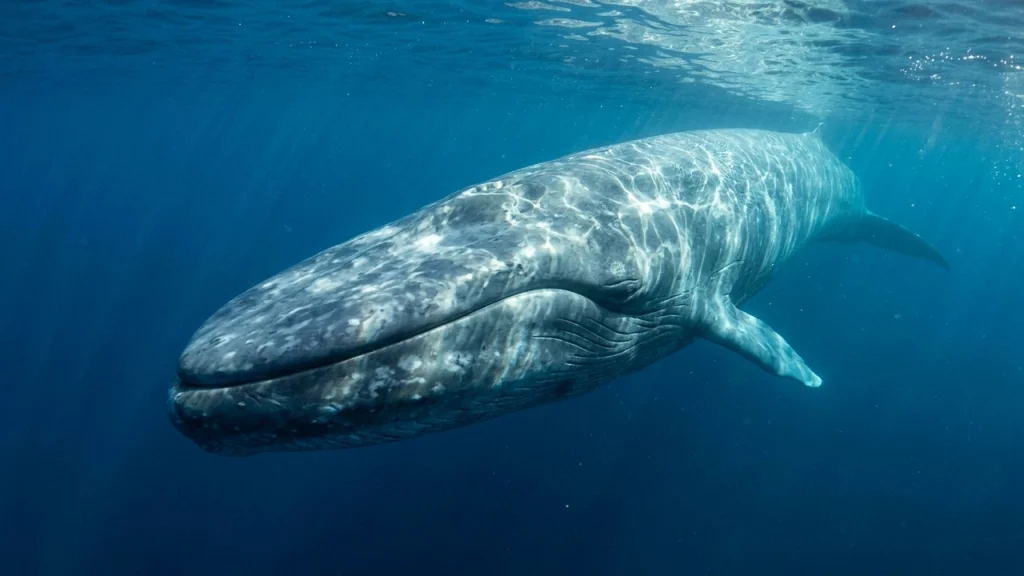
NOAA Fisheries states that once caught, whales may pull snagged tackle across vast distances, potentially causing exhaustion, impaired feeding capacity, or serious injury, which may lower reproductive success and bring about death. According to NOAA Fisheries, noise pollution can threaten whale populations by disrupting their usual routines and pushing them out of areas vital to their survival.
As global ocean temperatures steadily climb, anomalous warming pulses known as marine heatwaves occur with greater regularity and increased intensity. Research into whale foraging shows that during an extreme warm-water period in the summer of 2016, swarms of krill became much sparser than under normal upwelling regimes, relocating farther away from shore while the whales showed a corresponding seaward shift. Research examining environmental conditions and heatwaves found that marine predators remain vulnerable to warming pulses through connections linking prey availability, foraging effort, and reproductive output.
Sources
- NOAA Fisheries: Blue Whale | NOAA Fisheries
- Animal Diversity Web: Balaenoptera musculus (blue whale)
- PLOS ONE: High mortality of blue, humpback and fin whales from modeling of vessel collisions on the U.S. West Coast suggests population impacts and insufficient protection
- Integrative Zoology: Diel differences in blue whale (Balaenoptera musculus) dive behavior increase nighttime risk of ship strikes in northern Chilean Patagonia
- Ecology and Evolution: Environmental conditions and marine heatwaves influence blue whale foraging and reproductive effort