
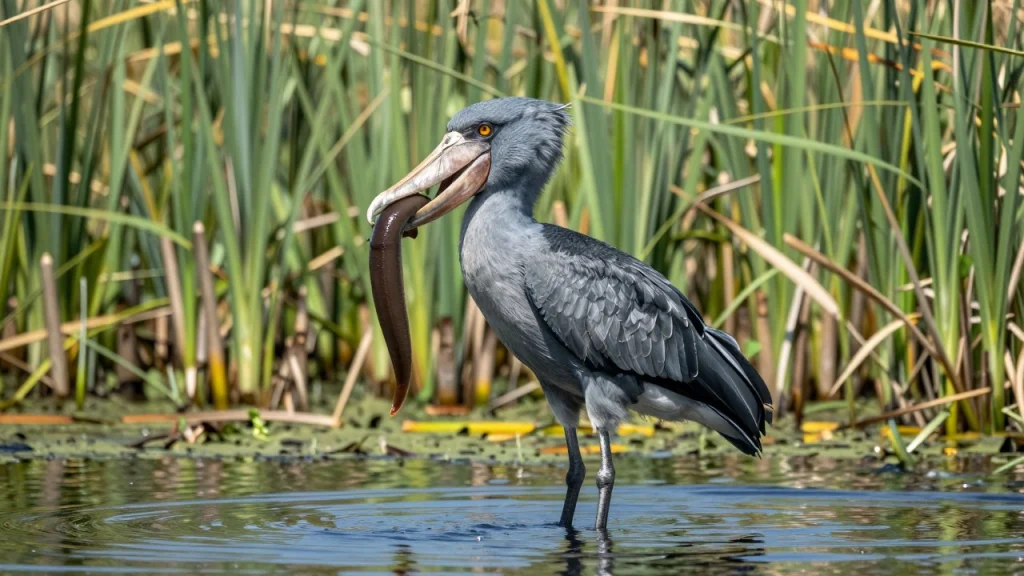
A shoebill hunts almost entirely in water, and fish make up the core of its meals. Lungfish first defines the menu, supported by bichirs, catfish, tilapia and watersnakes that live in the same marshes.
This whale headed bird, known to science as Balaeniceps rex, spends much of its day wading and watching for movement. It adds variety when wetlands offer it, taking frogs, reptiles, mollusks and dead animals left by other predators.
Why lungfish anchor the menu
Lungfish tolerate low oxygen and crowded pools, so they surface often and stay catchable through dry spells. That reliability matters for a tall wader that pays a high energy cost for every strike.
Shoebill range maps closely onto waters where papyrus grows and lungfish swim. Where those two overlap in east central Africa, the birds can feed through much of the year without long travel.
Zoo keepers describe lungfish as the favorite, with eels and catfish close behind. Big fish pay best because one capture delivers many calories for relatively little chase.
More than fish when wetlands allow
A strict fish diet would leave gaps, so shoebills widen the net with seasonal prey:
- baby crocodiles seized during patient waits in shallow pools
- frogs and water snakes grabbed after rains raise activity
- lizards that bask near channels, including young monitors
- turtles and mollusks crushed or pried from muddy edges
- carrion picked up when fresh kills are scarce
- rodents and small birds caught during rare dry ground forays
This flexibility helps pairs raise chicks even when favored fish dip. It also explains why one nest may contain fish bones while a neighbor shows turtle shell and snake remains.
How a statue becomes a strike
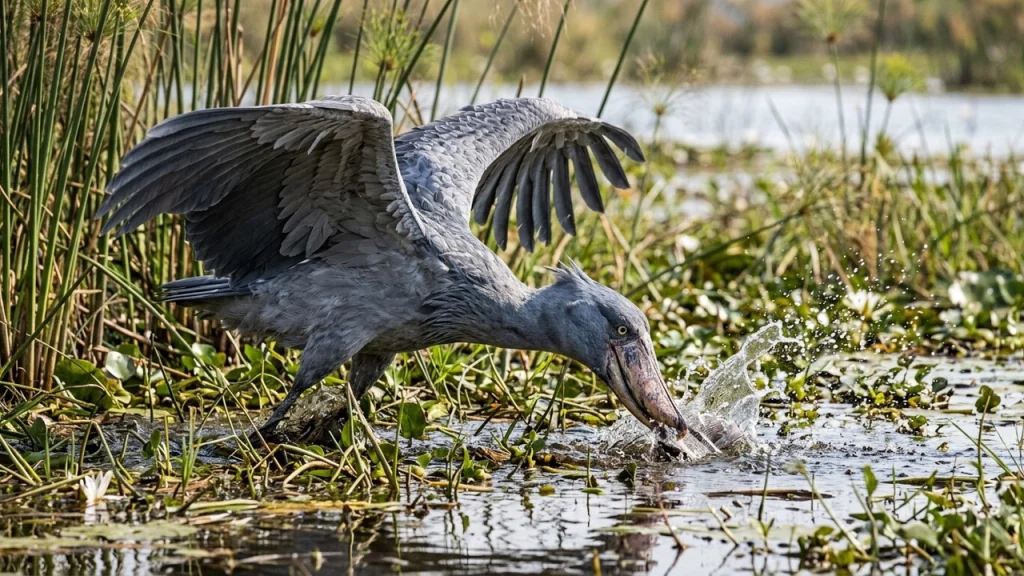
Shoebills feed mainly by ambush, freezing for long stretches before exploding forward. Stand and wait is one tactic, while slow wading through grassy shallows is the other.
Shallow water edged with tall plants gives ideal cover for stalking. The streaked gray body breaks up among stems, and the bird can inch closer without ripples that warn fish.
Vision leads the hunt, backed by sharp hearing for splashes under cover. To judge distance, the bird drops its head straight down and lines both eyes on one spot.
When prey appears, the neck shoots out and the body pitches forward in a collapse. The head and neck drive down fast, tipping the whole bird toward the water in less than a blink.
A reinforced bill and skull absorb that shock. Sharp cutting rims then grip slippery bodies that would slide from a weaker beak.
Cleaning the catch before swallowing
A strike scoops vegetation and mud along with the target. The bird keeps its grip and sweeps its head sideways to shake that debris loose.
Most prey loses its head before it goes down the throat. Decapitate then swallow lowers the risk of spines, teeth or thrashing inside the gullet.
The bill itself works like a tool shaped for the job. Keepers compare its profile to a hook tipped clog, broad through the base and curved to a point.
Fine rims along the mandibles help seize and slice. Those edges turn a lungfish that can twist hard into a meal that can be handled safely.
Where dinner is served
The classic feeding flat is a freshwater swamp with wide marsh and open pools. Floodplains broken by papyrus beds and reed islands give both shelter and lanes for wading.
In deeper spots the birds insist on floating mats strong enough to stand on. Without that raft, they cannot steady themselves for the lunge.
Low oxygen pools are surprisingly productive because fish rise to gulp air. Each surfacing shortens the distance to the bill and raises the odds of success.
Pairs that nest together often dine apart. Even mated birds work opposite ends of a territory, which spreads pressure across the marsh.
Shoebills rarely gather, and crowds form only when food runs short. That solitary habit keeps disturbance low around favored channels.
Most birds stay resident while fishing stays good. Some shift between nesting ground and feeding flat as water levels change through the season.
From hatchling to skilled fisher
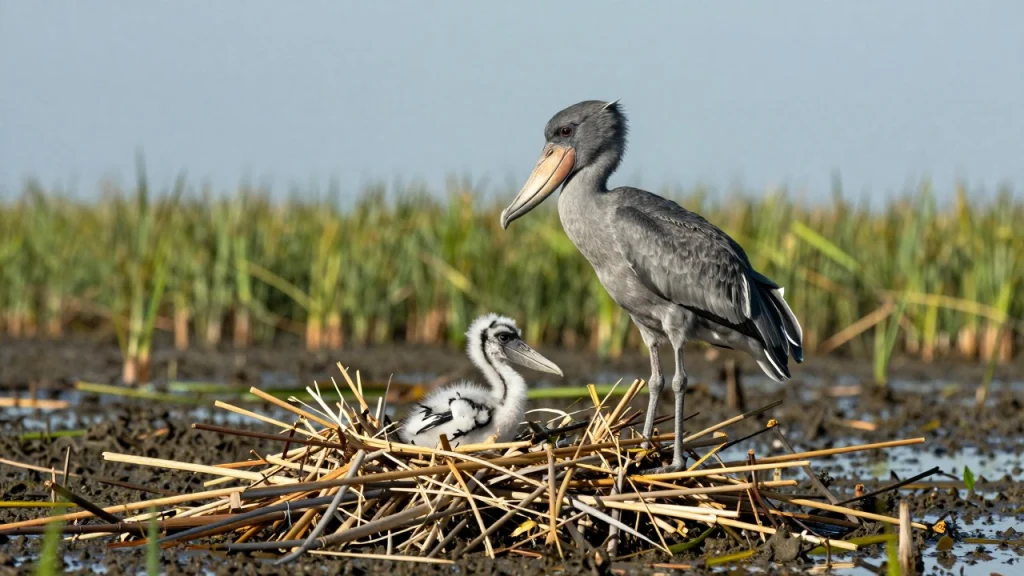
Courtship leads to a clutch of 1 to 3 eggs laid on a trampled island of grass. Both adults then share warming duty for about 30 days until hatching.
New chicks cannot feed themselves, so parents bring meals of softened fish. Early on the young receive regurgitated food 1 to 3 times daily, rising to 5 to 6 feeds as they grow.
Adults set the food down and let chicks pick at it. That practice builds the head tossing and gripping moves they will need later.
Growth is slow, and often only one chick survives, whether from predation or thin food supplies. That hard math shows why a dependable supply of large fish matters so much.
Built for wading work
Adults reach 110 to 140 cm in height, with males standing taller and carrying longer bills. A weight near 12 lbs rides on long dark legs built for soft ground.
Wings stretch about 7.7 ft across, wide enough to ride warm air above the territory. Soaring saves energy between far flung pools.
Toes run very long and spread wide with no webbing between them. That snowshoe effect spreads body mass across floating plants.
Plumage stays slate gray with darker tones on the head. Cryptic color plus stillness makes the hunter look like a stump until it moves.
Why this diet needs protection
Shoebills are listed as Vulnerable, pressed by marshes converted to farmland and grazing land and by fishermen disturbing their feeding areas. When shallow hunting grounds vanish, lungfish strongholds go with them.
Wild birds can approach almost 36 years of age, so adults may use the same wetlands for decades. Long lives help them learn hidden channels, but they also mean slow replacement when numbers fall.
Protecting papyrus marsh, keeping flood cycles natural and giving nesting pairs space does more than save a striking bird. It keeps intact a food web where lungfish, catfish, snakes and crocodile hatchlings all play linked roles.