
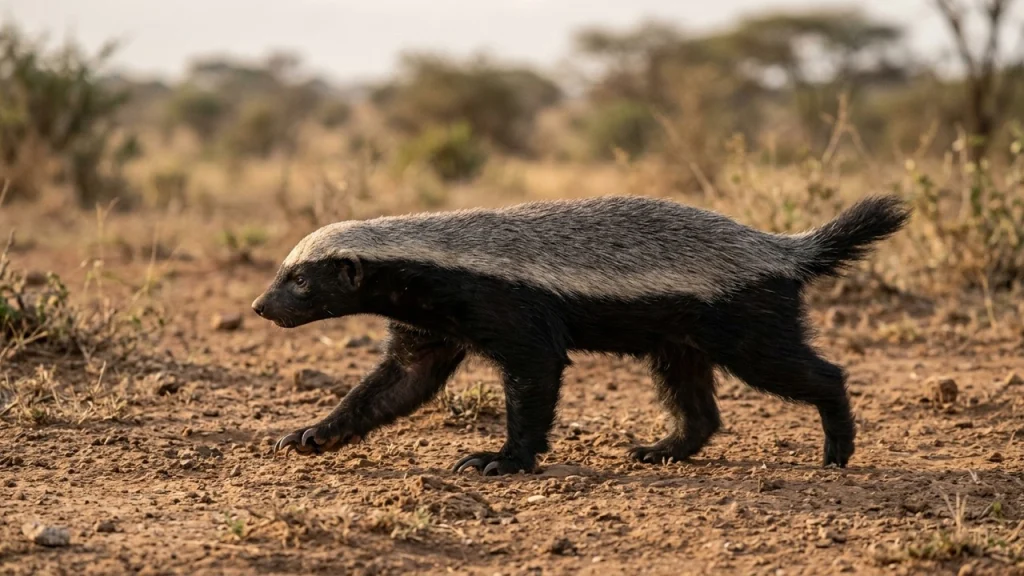
The honey badger (Mellivora capensis), also recognized as the ratel, possesses a reputation as one of nature’s most formidable and unyielding middleweight predators. When readers investigate how big is a honey badger, they encounter an animal engineered with an exceptionally dense, muscular frame rather than towering stature. Adult honey badgers are classified as large mustelids with a head-and-body span measuring 60 to 70 cm and an overall mass spanning 8 to 12 kg. A separate measurement lists overall length at 29 to 38 inches, or 73 to 96 centimeters. Their compact caudal appendage adds another 5 to 9 inches, equivalent to 14 to 23 centimeters, to their total length.
In addition to linear length, vertical height plays a decisive role in understanding their ground-hugging profile. In field surveys, an adult specimen stands approximately 25 cm high at the shoulder line, emphasizing a low-slung profile supported by a large skull along with muscular neck and shoulders. Shoulder elevation typically spans 9 to 12 inches, representing 23 to 30 centimeters when standing tall at shoulder height. A separate measurement lists adult mass at 13.6 to 30 pounds, or 6.2 to 13.6 kilograms. This low center of gravity gives them immense physical stability when excavating subterranean burrows or defending against apex carnivores.
Physical dimensions and structural build
The physical architecture of Mellivora capensis prioritizes mechanical leverage over leggy speed. Their low, flattened body rests on short, muscular legs equipped with elongated front claws tailored for digging and defense. This squat morphology minimizes vulnerable soft points, allowing the animal to squeeze inside tight rocky crevices and subterranean passages where larger predators cannot follow. Evolutionary biologists view body size as a fundamental functional metric for analyzing how organisms interact with their surrounding environments. For the honey badger, compact physical mass translates directly into fossorial efficiency and devastating defensive resilience.
A standard measurement profile illustrates their unique proportions:
- Total head-and-body length: Ranges from 60 to 70 cm.
- Tail length: Extends 5 to 9 inches (14 to 23 centimeters).
- Shoulder height: Measures 9 to 12 inches (23 to 30 centimeters, or roughly 25 cm).
- Adult weight range: Typically spans 8 to 12 kg.
These physical dimensions establish the honey badger as a heavyweight among terrestrial mustelids, combining the burrowing power of badgers with the aggressive tenacity of wolverines.
Sexual dimorphism and geographical size variation
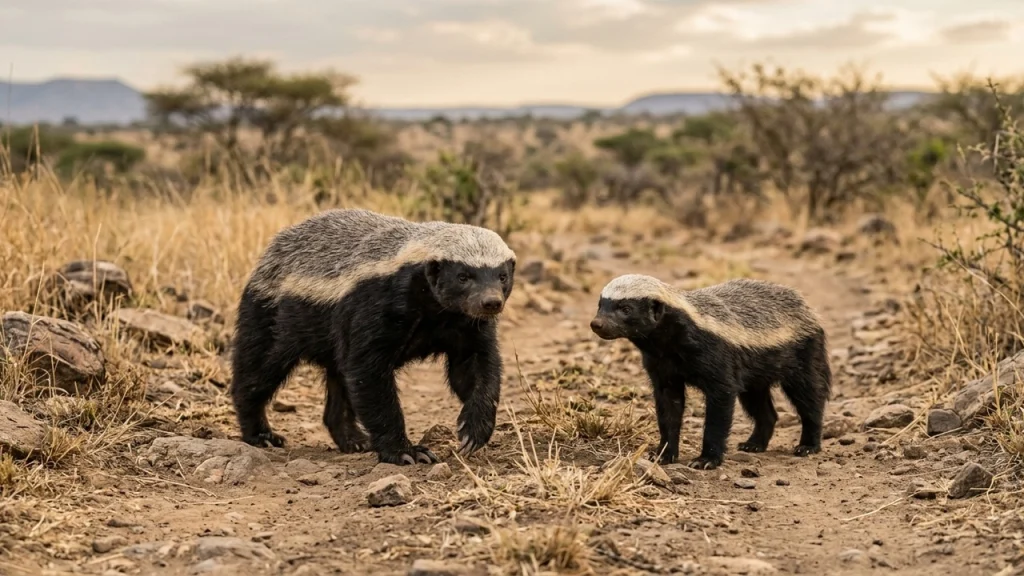
Size within the species is not uniform across sexes or continents. This mustelid species displays distinct sexual dimorphism where adult males grow noticeably larger than females. In wild populations, male badgers consistently outweigh adult females.
Long-term research reveals that Kalahari adult males exceed mature females by roughly one third in total size. This substantial disparity influences behavioral patterns, territorial patrolling, and energy budgets. Mature males frequently carry pronounced dorsal scar tissue from bites sustained during aggressive social combat.
Geography also exerts a measurable influence on physical size across different biomes. Body proportions also fluctuate geographically, with African populations measuring slightly larger than their Asian counterparts. Across arid savannas, woodlands, and rocky hillsides, local prey availability and climatic regimes fine-tune adult skeletal proportions.
Anatomical weaponry and defensive adaptations
A honey badger’s weight is backed by specialized anatomical tools designed for excavation and predation. The front paws are remarkably broad and muscular, bearing elongated claws that assist in grasping prey and running across harsh terrain. These curved front claws function like heavy earthmoving picks, cutting through compacted soil, baked termite mounds, and tree roots. The rear feet are noticeably smaller and feature shorter claws. This contrast provides strong rear traction while the broad forelimbs perform explosive digging.
Beyond its limbs, the pelage and integument of the honey badger serve as an impregnable suit of biological armor. An extraordinarily thick, loose hide enables the honey badger to endure bee stings, porcupine quills, and bites from attacking dogs. The skin sits so loosely over the underlying muscle that if an assailant grabs the badger by the neck, the animal can twist inside its own skin and turn its jaws around to retaliate.
The coloration of the animal features a distinct contrast known as countershading reversal. Dense, coarse dark fur covers the lower body, while a broad gray-white band traverses the back from the cranial crest down to the tip of the tail. A distinctive light mantle covers the upper surface of the body. This sharp coloration makes the badger conspicuous across open ground, warning potential enemies of its dangerous counterattacks.
In addition to mechanical armor, the honey badger possesses biochemical protection against hazardous quarry. Honey badgers utilize rapid agility to ambush substantial prey items and venomous snakes, relying on a dense coat for physical defense. When confronting deadly elapid serpents such as cobras, the badger relies on genetic adaptations. A specific arginine mutation at position 187 of the nicotinic acetylcholine receptor provides physiological immunity against neurotoxic cobra bites. This molecular safeguard allows the predator to survive bites that would promptly kill other medium-sized carnivores.
Growth stages from newborn to adult size
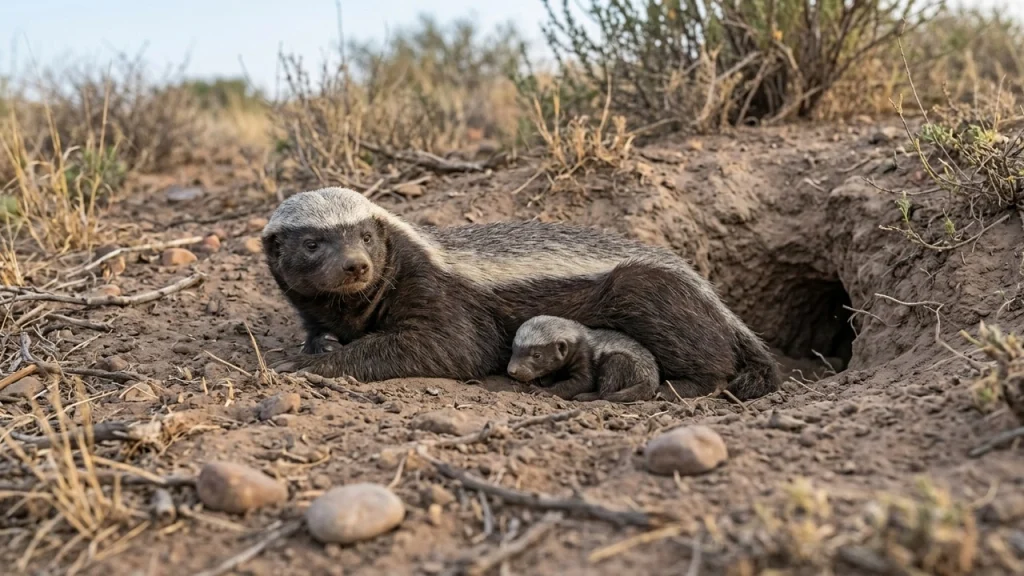
The journey from a vulnerable infant to an imposing adult requires intensive maternal dedication. Following a gestation duration spanning 7 to 10 weeks, litters usually produce a single cub, or rarely two offspring. At the moment of birth, newborn cubs register an average weight of about 7 ounces (20 grams). At two days after birth, a captive newborn was entirely hairless and weighed just 0.23 kg.
Young badgers experience rapid anatomical transformation during their nursery phase inside underground dens. Young badgers develop a dense, patterned pelage resembling adult coloration by three months of age. Juveniles achieve their full adult frame by 6 months of age, but remain with their mother until 14 months to 2 years to master hunting techniques. Young honey badgers of both sexes gain full independence at an average milestone of 14 months. This protracted dependency guarantees that cubs master complex excavation, snake handling, and defensive tactics before roaming solitary ranges.
Energetic demands and predatory ecology
Maintaining a stocky, muscular body requires an enormous amount of daily caloric fuel. These carnivores lead wide-ranging nomadic lives as they track ephemeral resources. They do not occupy permanent residential shelters, instead digging fresh resting burrows or adopting vacant animal tunnels every few days.
Daily movement patterns reflect the distinct energetic requirements of each sex. Daily foraging circuits range widely by sex, with females covering roughly 10 km while active males traverse up to 27 km per day. To fuel their metabolic requirements, mature males consume an estimated mean of 1.3 kg of daily food, whereas adult females ingest about 0.9 kg per day.
The species targets a broad spectrum of animals across its range. Field observations show honey badgers taking prey items that weigh between 2 to 2000 g. Their daily diet includes scorpions, rodents, lizards, snakes, bird eggs, and bee larvae and honey raided from wild hives.
Their anatomy also creates specific physical limitations. Because honey badgers cannot leap, beekeepers effectively protect their hives simply by mounting boxes several feet above the ground. Elevating apiaries removes honeycombs from their reach, eliminating lethal conflict between commercial beekeepers and hungry badgers.
Evolutionary lineage and survival status
The modern honey badger represents a unique, isolated offshoot in mammalian evolutionary history. Within the order Carnivora, the family Mustelidae contains 59 recognized species grouped into 22 distinct genera. Early evolutionary splits within the family separated lineages such as Taxidea and Mellivora alongside Meles between an estimated 20.7 and approximately 16.4 Mya. The genus Mellivora diverged early from typical weasels and martens, preserving a rugged, heavy-boned body plan that has endured across millions of years.
This ancestral resilience enables the modern honey badger to colonize broad geographical zones. Honey badgers adapt to diverse landscapes across an expansive elevation gradient extending from 0 to 4050 m, which translates into 0.00 to 13287.40 ft. While wild longevity remains unconfirmed, captive individuals can survive up to 26 years under expert care. The IUCN Red List designates the honey badger as a species of Least Concern due to its vast geographical distribution and generalist feeding behavior. Through an extraordinary combination of heavy bone structure, loose defensive skin, and versatile dimensions, the honey badger continues to thrive across the wilderness of Africa and Asia.
Sources
- Animal Diversity Web: Mellivora capensis (honey badger)
- San Diego Zoo Wildlife Alliance: Honey Badger (Ratel) | San Diego Zoo Animals & Plants
- World Wildlife Fund: Adopt a Honey Badger | Symbolic Adoptions from WWF
- Wiley: Genomic Insights Into the Body Size Evolution in Mustelidae (Mammalia: Carnivora)
- MDPI: Make Acetylcholine Great Again! Australian Skinks Evolved Multiple Neurotoxin-Proof Nicotinic Acetylcholine Receptors in Defiance of Snake Venom