

In the wild, these big grazers gather in steady herds centered on roughly 10 mature members, which keeps daily routines predictable and lowers the urge to chase or confront nearby creatures.
They are the heaviest living gnawing mammals on Earth, and their days center on steady grazing and long rest spells near water.
That easygoing pattern often reads as friendliness, yet wild animals do not seek close company and they retain a strong instinct to guard feeding spots and wallows used for cooling and rest.
After repeated unsettling encounters with people, local animals turn timid and shift much of their activity into night hours, so daytime tolerance never guarantees comfort with close approach.
Why steady herds can seem gentle
Family parties often center on a leading male alongside multiple adult females, junior males and young of various ages, and that mixed age structure spreads vigilance across many eyes while letting youngsters learn calm responses.
Ties among herd mates stay strong through mutual touch, odor marks and constant calls, which explains why companions often rest packed together and move as a coordinated unit rather than scattering.
Mutual cleaning eases friction inside the herd while also stripping away skin pests, so close physical contact serves hygiene and social bonding more than any desire to greet other species.
Calm herd life therefore reflects organization and familiarity, not affection for humans, and quiet observers usually get the longest views when they avoid breaking that rhythm.
What herd size signals to observers
In lush months the same herds stay compact, while drier spells can pull together gatherings numbering up to 40 animals near remaining water, a flexible response to shrinking water and patchy forage.
Elsewhere researchers have recorded bands spanning from 3 to 30 members, a spread that reflects food supply, shelter quality and local pressure rather than a fixed rule for every landscape.
- Compact family units show steady membership and coordinated movement, so patience earns longer views than crowding.
- Larger seasonal gatherings focus on water access, so crowding never means the animals want closer human contact.
- Lone animals remain uncommon and face tougher odds alone, so a solitary individual deserves extra space.
How water and timing shape encounters
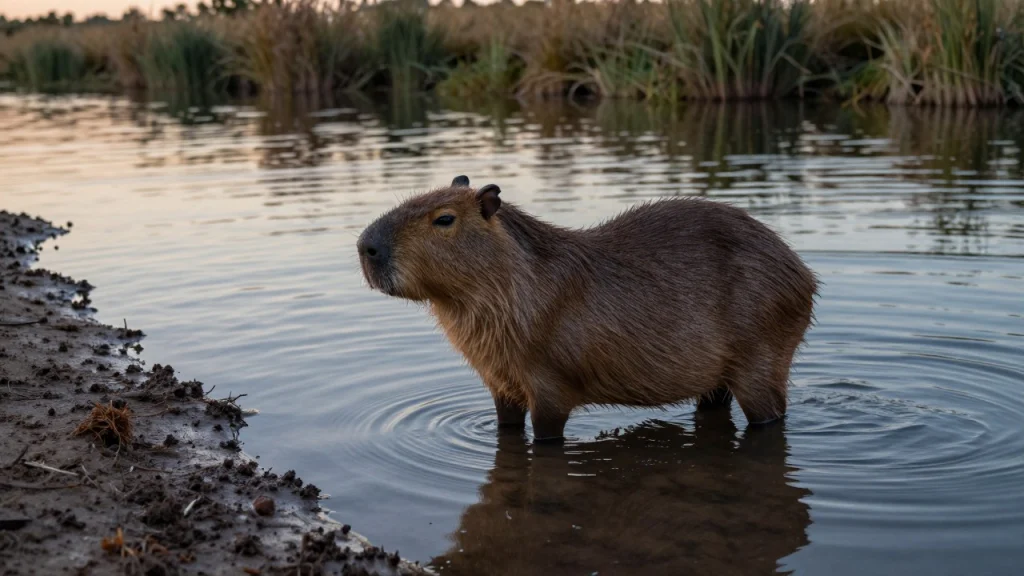
They settle solely where open water stays within easy reach, favoring soggy meadows, marsh borders and riverside woods that offer steady grazing plus year round drinking, which is why trails near banks produce most sightings.
They favor dawn and dusk for movement and lounge half sunk during peak heat, which explains why midday sightings often show sleepy animals floating quietly instead of active grazers.
Field work shows that hunting risk, meal supply and shelter type decide whether local animals stay active by daylight or switch to night routines, so schedules can differ sharply between neighboring valleys.
Strong swimming lets them vanish beneath the surface for five minutes at a stretch to shake off pursuit, a talent supported by half webbed toes that work like paddles and give steady thrust in marshes.
High set vision, hearing and smell openings let them survey banks while keeping most of the torso concealed, so a partly hidden head at the surface often means a wary animal is already monitoring its surroundings.
Water dependence thus defines both comfort and escape, and people who block paths to the riverbank quickly turn a relaxed encounter into a stressful one.
What calls, touch and rank communicate
When danger appears, sentries utter a harsh call that sends companions hurrying toward the safety of water, a chain reaction that protects slow young more than it threatens onlookers.
When a lookout sounds an alarm, nearby members freeze briefly or dash straight into the closest water, so sudden silence followed by splashing signals that observers should pause or step back.
Strange arrivals get loud warnings at first, and residents may dive into the river or trot away when pressure builds, which shows that vocal protests aim to create distance rather than start contact.
Among grown males, rank stays firm and disputes get settled mainly through pursuits, with outright clashes happening only on rare occasions, so most tension stays inside the herd and away from people.
Herds guard home areas against neighbors, a habit that keeps feeding spots from becoming overcrowded and helps each family learn exactly where refuge water lies.
- A sharp warning call followed by a dash toward water means the herd feels threatened and needs room.
- Freezing with only nose tip plus eyes visible shows concealment, not invitation to come closer.
- Repeated protests near intruders followed by flight into the river signal that approach went too far.
Meals, young and lifespan in natural settings
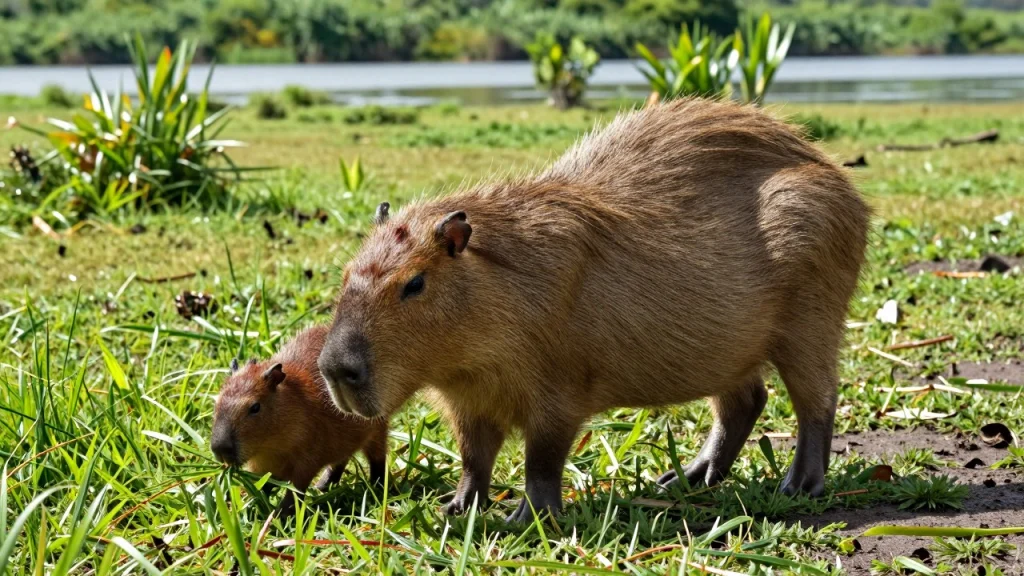
Meals center on fresh leafy growth plus water vegetation, so they spend long spells clipping and grinding soft riverside forage that suits broad grinding teeth and a capacious gut.
A full grown individual may munch through 6 to 8 pounds of grass per day, which shows why constant access to pasture matters more than occasional treats and why herds rarely stray far from green banks.
Females generally rear a yearly cohort of four to five young, so youngsters often appear in small playful clusters that stay near adults for protection and shared nursing.
Typical longevity reaches around 6 years in natural settings, with exceptional individuals attaining 10 years there and 12 years under human care, a span that rewards stable groups where knowledge of safe water persists.
Grown animals often tip the scales at 35 to 66 kg, stand 0.6 meters tall at the withers and extend about 1.2 meters from nose to rump, dimensions that require substantial daily forage.
Slow growth and shared care make each birth season important, and disturbance near nursery groups carries outsized costs because tired young depend entirely on adult vigilance.
How to watch wild capybaras with care
Global assessors classify them in the least concern bracket, citing broad numbers, wide spread and regular presence inside protected zones, yet that status describes populations rather than promising tameness in any animal.
This rodent lacks an endangered tag at present, yet woodland clearance, living space loss and unlawful killing still press on it in parts of its range, which further explains why some groups vanish quickly when disturbed.
- Keep distance and watch quietly near marsh borders without blocking paths to water.
- Favor dawn or dusk viewing when movement peaks, and allow midday rest in water to continue undisturbed.
- Let warning calls guide conduct, since retreat to water means the encounter should end.
Patient, distant observation honors the social calm that makes capybaras appealing while leaving wild herds free to graze, bathe and raise young on their own terms.
Sources
- Animal Diversity Web: Hydrochoerus hydrochaeris (capybara) | INFORMATION
- San Diego Zoo Wildlife Alliance: Capybara | San Diego Zoo Animals & Plants
- San Diego Zoo Wildlife Alliance: Behavior & Ecology – Capybaras (Hydrochoerus spp.) Fact Sheet
- National Geographic: Capybara Facts
- Sacramento Zoo: Capybara | Sacramento Zoo