
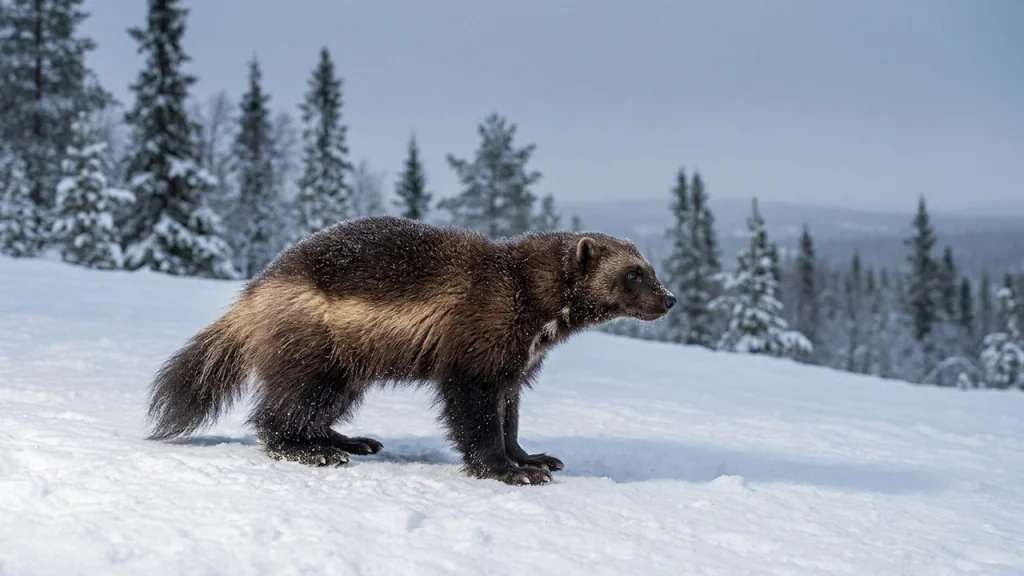
Yes, the wolverine is the bigger animal, and on most measurements it is not close. The two belong to Mustelidae, the weasel family, yet they sit at opposite ends of the size scale inside it. A wolverine’s mass ranges from 9 to 30 kg, while the honey badger’s runs from 8 to 12 kg.
The honest qualification is that those two weight ranges touch. The lightest adult wolverines are no heavier than the heaviest honey badgers, so a small wolverine female and a large honey badger male can carry a similar load. Size settles the question when you look at the whole animal: a wolverine is longer, stands considerably taller at the shoulder, and is bulkier through the body.
There is a second catch worth stating up front. The two species never meet in the wild. A wolverine’s range reaches across North America and northern Eurasia and follows the boreal belt, while the honey badger is spread across most of sub-Saharan Africa and the Arabian peninsula, and it also holds the Indian subcontinent, from India into Nepal and Pakistan. Any contest between the two is a thought experiment rather than a recorded encounter.
Cousins at opposite ends of the size scale
National Geographic describes wolverines as cousins to honey badgers, otters and ferrets, and the San Diego Zoo describes the honey badger as a weasel family member linked to skunks, otters, ferrets and badgers. Alaska wildlife officials name the wolverine as the family’s largest ground-dwelling member, which is the formal reason it outweighs the honey badger.
Beyond kinship the two share a build. The wolverine is built compactly, with a heavy frame, short powerful limbs, a broad head and small rounded ears, and it has a powerful jaw with large neck muscles that lets it crush bone. The honey badger is described in much the same terms, a stocky animal with a large skull and a muscular neck and shoulders. The wolverine’s scientific name, Gulo gulo, means “glutton” in Latin, a nod to a feeding strategy that has nothing to do with size.
How the numbers break down
- Body length: wolverine 65 to 105 cm, honey badger 60 to 70 cm
- Shoulder height: wolverine 36 to 45 cm, honey badger about 25 cm
- Tail length: wolverine 13 to 26 cm
- Typical adult wolverine weight (Alaska data): males 11 to 18 kg, females 6 to 12 kg
- Wolverine sex difference: females run about 10% smaller in linear measurements, with a 30% gap in weight
- Honey badger size variation: African individuals measure slightly larger than Asian ones
Every measure points the same way, so a wolverine reads as a longer, taller and heavier animal with a long tail rather than a marginally bigger one.
What the wolverine’s extra size buys
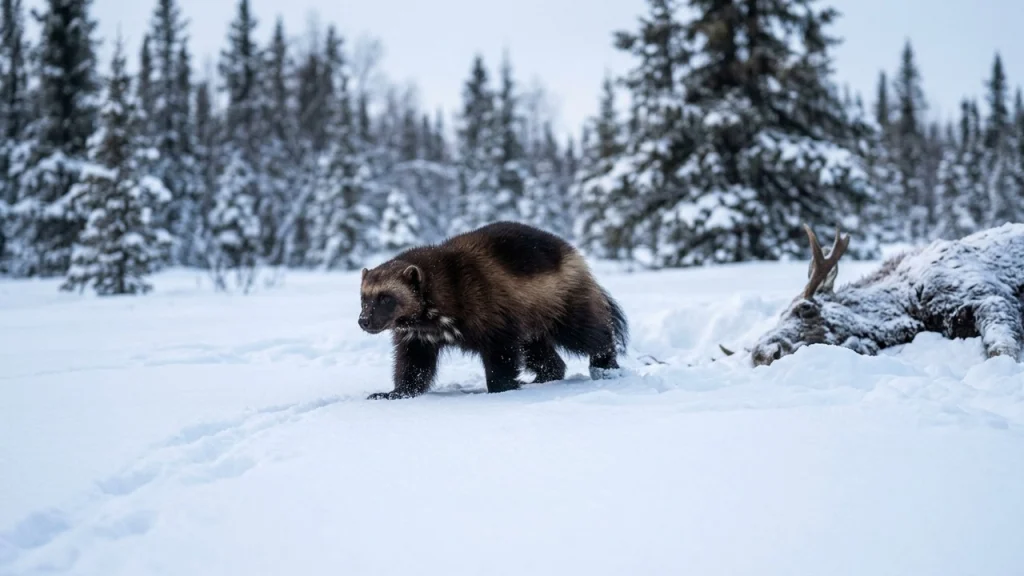
A wolverine walks with its weight carried on the metatarsals rather than up on the toes, a posture that spreads that weight across the whole foot. That is not padding, it is snow equipment. In deep snow wolverines sink less than most animals, so they can catch prey far heavier than themselves that has become stuck in place, and they are recorded taking animals five times their own size when the snow has stranded large prey. On hard ground the advantage reverses, because hoofed mammals can outrun them.
Much of the winter diet is carrion, the leftovers of moose and caribou, so the size advantage pays off at a frozen carcass rather than in a fight. The build that makes a wolverine formidable in snow is the same build that leaves it dependent on finding other animals’ kills.
Why the smaller honey badger is hard to hurt
The honey badger answers a size gap with skin. Its hide is unusually thick and loose, loose enough that an animal seized from behind can turn inside it and bring its teeth to whatever is holding it. The San Diego Zoo says the hide shrugs off bee stings, porcupine quills and even bites from dogs.
That protection is not theoretical. According to Animal Diversity Web, lions and leopards usually kill the old and the weak, because the loose hide of a healthy adult is difficult to get a firm grip on. The same account notes that the black body with a pale mantle across the back resembles a baby cheetah, which may give a hunting predator pause.
Two further habits work in the badger’s favour. A foul-smelling liquid as powerful as a skunk’s waits in a tail-base gland and is released when the animal is frightened, while long front claws let it dig burrows up to 3 m long and 1.5 m deep. Much of its life is therefore spent in a chamber underground rather than in confrontations it never chose.
Lifespan, cubs and the space each needs
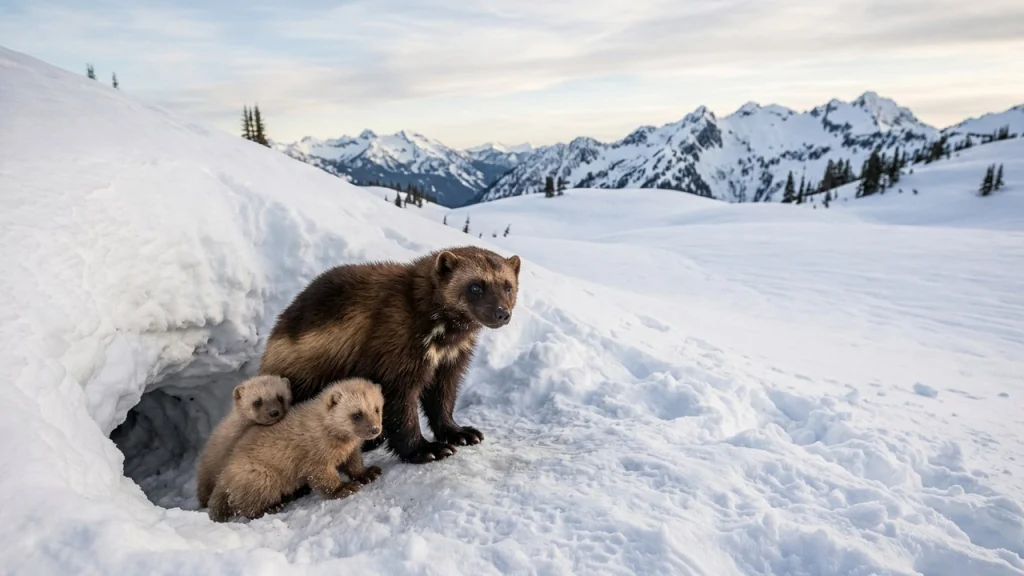
A wild wolverine usually gets 5 to 7 years, though some reach 13. A wild honey badger usually manages 7 to 8 years, so the smaller animal is not the short-lived one. Neither species is social: wolverines meet only to mate, while honey badgers live alone and roam over wide areas.
Reproduction is slow in both, and the wolverine stretches it further. A female stays pregnant for about 215 days after a breeding season that runs from April to August, then raises her litter in a snow den dug deep into the drift, its tunnels reaching 15 feet from the surface. A litter can number from 1 to 6 pups, though two or three is the usual result. A honey badger’s pregnancy lasts 50 to 70 days, she raises a single cub, and that cub stays with her for 12 to 16 months, with cubs of either sex leaving her around 14 months of age.
Space tells the same story as body size. In the southern Kalahari, adult male honey badgers hold home ranges averaging 541 sq km, and those ranges overlap heavily because the animals do not defend territory. In Denali, wolverine home ranges run from 100 to 800 sq km. Both are moving across country that most people would call empty.
Where the two species stand
The IUCN lists both species as Least Concern, so the shared wording hides two very different situations. The wolverine’s global status sits alongside a species that has all but vanished from the United States and from southeastern and south-central Canada, with Scandinavian density estimates as low as one animal for every 200 to 500 sq km, and with European populations judged to sit at higher risk. The honey badger’s listing rests on the fact that the population is declining but the range is broad and the diet is not narrow, even so its overall population shows a decreasing trend, and people are the largest threat: individuals die by design or by accident, killed with traps and poison baits set by farmers and apiculturists, and others are taken for traditional medicinal remedies.
Reading the size gap for what it is
The wolverine wins on bulk, and its measurements explain why it is built that way. Snow decides the argument: broad feet, a low stance and a heavy frame let a wolverine work carcasses and trapped ungulates that no lighter animal could reach. The honey badger trades size for a body that is awkward to hold and unpleasant to bite, which is why big cats leave healthy adults alone and why its reputation outstrips its mass.
So this is not really a contest. One animal is the northern heavyweight built for cold ground and long stretches between meals, the other is a fighter from Africa and southern Asia that survives by being unpleasant to eat. Size settles the numbers, and durability settles the reputation.
Sources
- Animal Diversity Web: Gulo gulo (wolverine) | INFORMATION | Animal Diversity Web
- Animal Diversity Web: Mellivora capensis (honey badger) | INFORMATION | Animal Diversity Web
- Alaska Department of Fish and Game: Wolverine Species Profile, Alaska Department of Fish and Game
- U.S. National Park Service: Wolverines (U.S. National Park Service)
- San Diego Zoo Wildlife Alliance: Honey Badger (Ratel) | San Diego Zoo Animals & Plants
- National Geographic: Wolverine, facts and information | National Geographic