
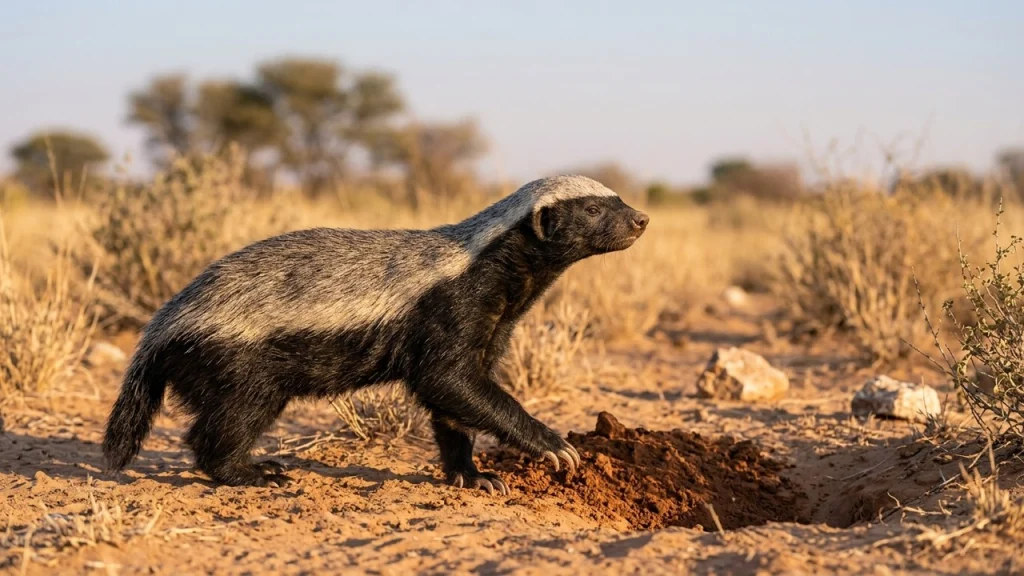
Honey badgers have a reputation for being clever, but the reliable sources on the species describe behavior rather than test scores. What they document is an animal with a highly flexible way of finding food, a habit of avoiding danger when it can, and a willingness to fight when it cannot. Those traits are the best evidence we have of how a honey badger thinks.
This article looks at what field research and zoo fact sheets say about how honey badgers hunt, dig, climb, defend themselves and deal with rivals, and what each of those behaviors suggests about their mental flexibility.
Flexible foraging is the clearest sign of a versatile mind
Honey badgers are opportunistic foragers, and their diet shifts with the seasons as different prey becomes easy to find. An animal that switches its menu this way has to recognize and exploit whatever the environment offers at the moment.
The range of prey is wide. Researchers in the southern Kalahari recorded honey badgers catching animals from 2 to 2000 g, and the zoo fact sheet describes the menu as running from insects to young ungulates. The species takes:
- eggs, small rodents, snakes, birds and frogs
- fruit, roots and bulbs
- honeybees and their honey comb, along with solitary bee larvae
Seasonal switching
In the Kalahari, small mammals made up 80% of the diet during the season when they were most abundant (September to December). Large snakes then supplied 58% of the diet in the hot-wet season (January to April).
That pattern shows an animal tracking what is available rather than following a fixed routine. It is also why scientists describe the species as not being a dietary specialist.
Hunting dangerous prey
Honey badgers eat a variety of venomous snakes. The San Diego Zoo fact sheet lists mole snakes, puff adders and Cape cobras among the important prey, and notes that the cobra and adders are highly venomous.
Animal Diversity Web says this diet suggests some physical adaptations. So part of the snake-eating success may come from the body rather than the brain, which is worth keeping in mind before crediting every bold act to intelligence.
Digging, climbing and swimming widen the toolkit
Honey badgers use their front claws to dig, and they flick the soil back through their hind legs. They excavate their own burrows or move into ones that other animals abandoned.
They are not limited to the ground. Honey badgers scale rough, wide tree trunks and come back down tail first. They also swim and dive, and they have been seen submerging to catch turtles.
This mix of skills lets one animal exploit burrows, trees and water. That breadth of problem-solving habits is a large part of why the species looks so resourceful.
Ferocity backed by careful risk management
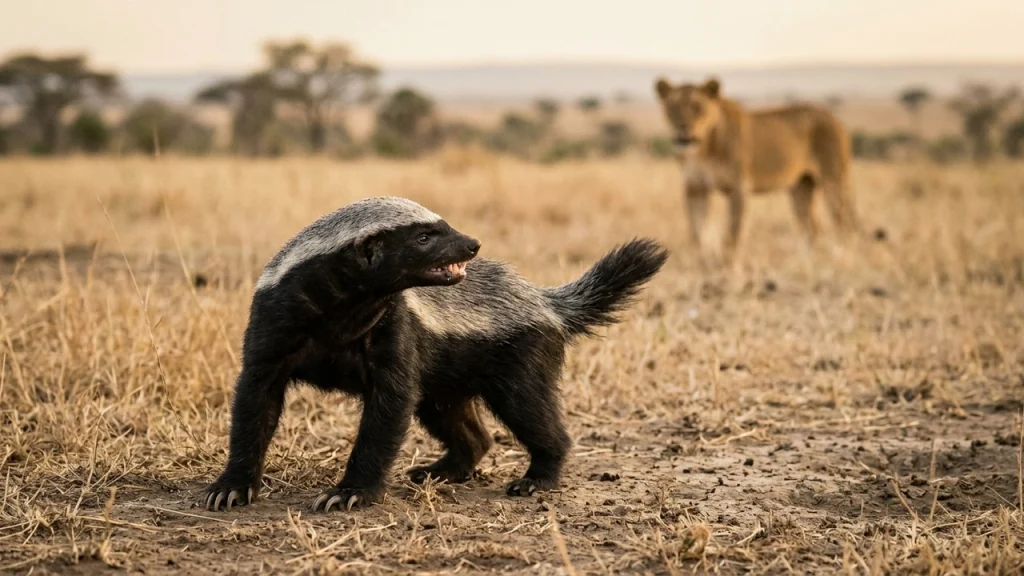
A honey badger’s toughness is not blind. Zoo sources say the animal actively avoids predators when possible. When avoidance fails, it usually stands its ground and fights instead of running.
Its body helps it win those fights. The very thick, loose skin stops a predator from getting a firm grip, so the badger can twist around and bite the attacker. Lions and leopards mostly manage to kill only badgers that are old or weak, since the loose skin of younger animals gives them little to hold.
Color may add a second layer of defense. The black body with a white mantle resembles a baby cheetah, which makes predators less likely to attack.
Social smarts: scent, rivals and mothers
Honey badgers communicate largely through smell. They mark territory with urine and with secretions from scent glands located in the anus, and this scent marking appears to matter when finding a mate.
Disputes between males can turn into ritual. When one male intrudes on marked burrows, the two begin a dominance dance to decide who stays. Play is uncommon, though males sometimes play-wrestle and tumble down hills.
Mothers invest heavily in their young, looking after their offspring for one to two years.
Does the honeyguide legend prove intelligence?
A popular story says the greater honeyguide, a bird, leads honey badgers to bee hives and shares the reward. Animal Diversity Web notes that this relationship is often described in the literature and popular media. Yet the San Diego Zoo fact sheet reports no indication of an association with the Greater Honeyguide.
The zoo sheet does describe another partnership. Rodents that flee from a digging honey badger are caught by other species, and the Pale Chanting-goshawk often follows badgers that are active by day. In that case the badger creates opportunities for birds rather than the other way around.
Range and daily travel show adaptability
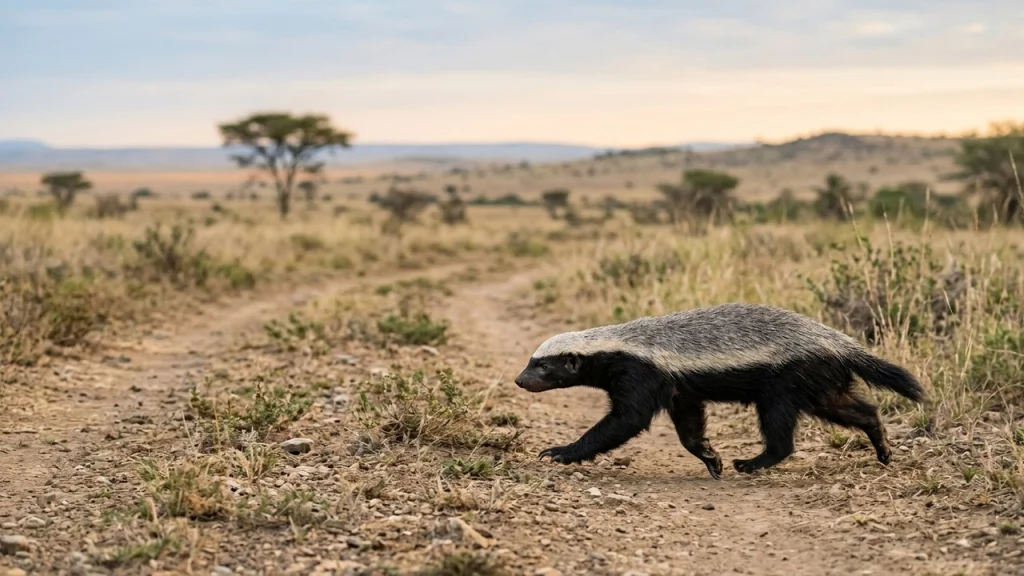
The species lives in a wide variety of habitats, from forests and woodlands to arid steppes, rocky hills and deserts. It occupies elevations from sea level to 4,050 meters, as long as it can find burrows or rock crevices for shelter.
It also covers long distances. A female covers about 10 km a day, whereas a male may range as far as 27 km daily. Such movement means constantly reading new terrain for food.
Honey badgers are predominantly nocturnal, though people not uncommonly see them in daylight. That flexibility in timing fits the same pattern as their diet and habitat.
What this means for their future
The IUCN Red List rates the species as Least Concern (2015 assessment). The population is declining, but the species has a broad range and is not a dietary specialist, so its adaptable habits work in its favor.
In the wild, honey badgers typically live 7 to 8 years, while those bred in captivity live 24 to 26 years. Human activity is probably the largest threat, since farmers often kill honey badgers with traps and poison baits.
The short answer
Honey badgers are behaviorally flexible, persistent and resourceful. They adjust their diet to the season, dig, climb and swim, avoid fights when possible, and settle rival disputes with ritual displays. The sources reviewed here do not give an intelligence measure, but the pattern of behavior points to an adaptable animal that solves a wide range of practical problems.
Sources
- Animal Diversity Web: Mellivora capensis (honey badger)
- San Diego Zoo Wildlife Alliance: Behavior & Ecology – Ratel/Honey Badger (Mellivora capensis) Fact Sheet
- San Diego Zoo Wildlife Alliance: Diet & Feeding – Ratel/Honey Badger (Mellivora capensis) Fact Sheet
- San Diego Zoo Wildlife Alliance: Population & Conservation Status – Ratel/Honey Badger (Mellivora capensis) Fact Sheet