
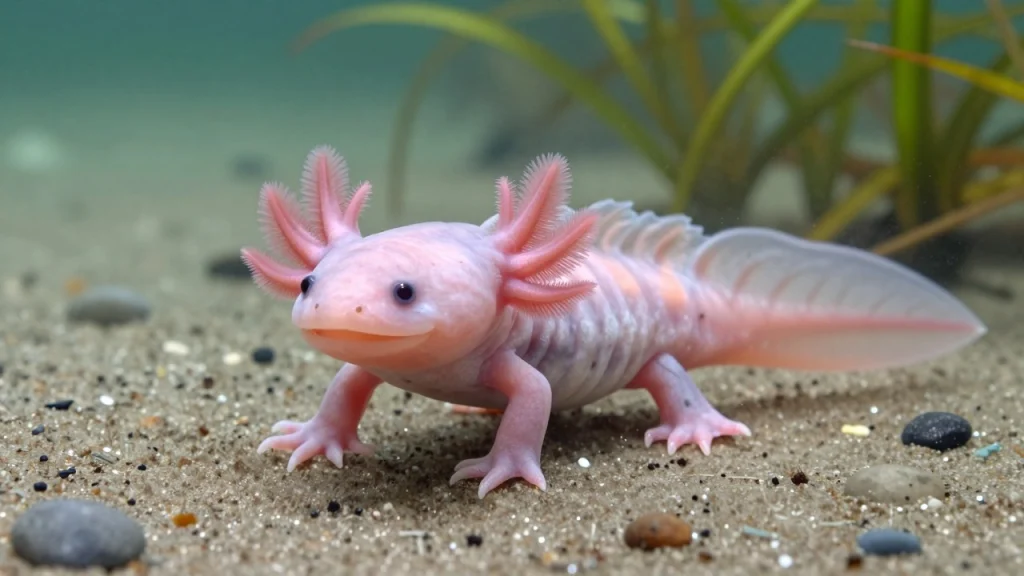
Biological marvels of the perpetual salamander
What cool things can axolotls do to thrive in freshwater habitats? Axolotls possess the remarkable capability to reconstruct damaged limbs, lungs, heart muscle, lower jaws, spines, and areas of their brain. Unlike most other amphibians that transform into land-dwelling adults, these aquatic wonders never surrender their larval features, navigating their native lake beds while preserving endless regenerative vitality.
Their extraordinary anatomy pairs effortless cellular repair with acute sensory tracking. Axolotls perceive environmental targets and track prey by sensing subtle electrical fields while simultaneously relying on visual and chemical sensory inputs. From evading hungry predators to snapping up elusive bottom-dwelling prey, these amphibians employ biological adaptations that resemble science fiction.
Flawless tissue renewal and blastema formation
The axolotl operates as nature’s premier master of regeneration. Following severe physical trauma, the salamander produces specialized regeneration-capable progenitor cells forming a cellular structure called the blastema that expands, patterns itself, and reconstructs the missing anatomical elements. This cluster of responsive cells coordinates regional signals, ensuring that new bones, nerves, and vessels emerge in seamless alignment.
Targeted biochemical signaling guides regeneration, where a specific enzyme and gene cooperate alongside retinoic acid to assemble the exact bodily component in the correct anatomical location. Because this guidance remains active throughout maturity, the animal builds anatomical replacements with flawless structural precision.
Laboratory observations demonstrate that an axolotl can rebuild an amputated leg up to five times perfectly within a few weeks without creating a scar. Every constituent tissue regenerates during healing, encompassing surface skin, underlying bone, joint cartilage, musculature, and active stem cells. Natural predators remain scarce in their aquatic ecosystem, although storks, herons, and introduced large fish including carp and tilapia occasionally prey upon them.
Because dense scar tissue normally blocks mammalian wound repair, decoding how axolotls heal without scarring could help medical researchers unlock regenerative treatments for people. Studying their undamaged wound recovery allows developmental biologists to investigate the genetic switches that spark comprehensive tissue renewal.
Cellular defense and cancer resilience
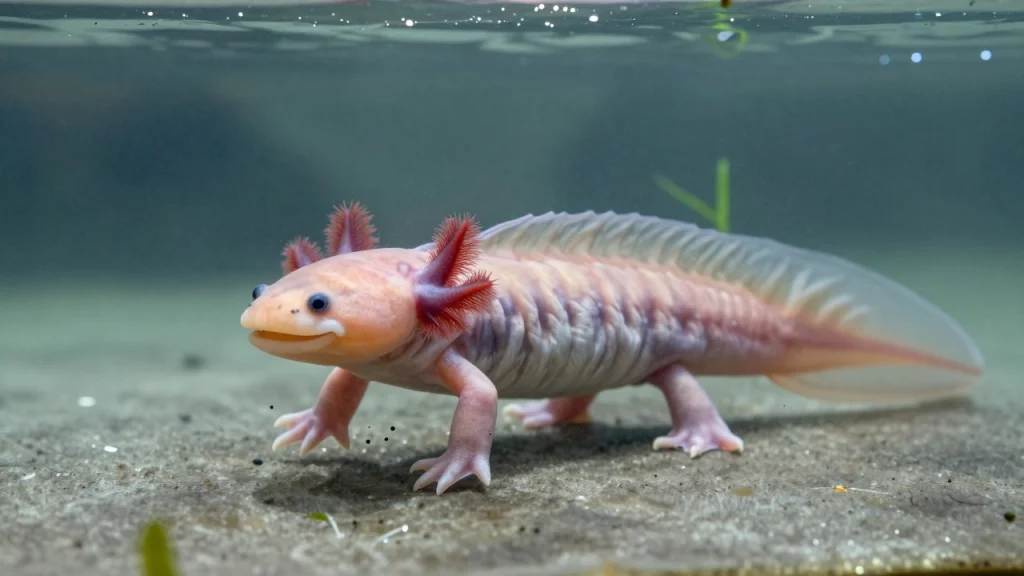
Axolotls pair their unparalleled healing talent with powerful cellular defenses against abnormal tissue proliferation. These amphibians show profound resilience against malignant diseases; their cancer resistance is said to be over 1,000 times higher than in mammals. Their biological safeguards prevent mutant cells from proliferating wildly even as rapid cell division occurs during blastema development.
This suppressed vulnerability to tumors provides biomedical researchers with an invaluable research model. By examining how axolotls regulate rapid cellular growth during limb reconstruction without developing cancerous tumors, scientists hope to discover therapeutic applications for human oncology and tissue engineering.
Permanent youth through neotenic development
While typical salamanders hatch as aquatic larvae, grow limbs, lose their gills, and walk onto land, axolotls choose a completely different life strategy. Axolotls exhibit paedomorphism by preserving immature larval traits even after attaining reproductive adulthood. This lifelong retention of youthful anatomy means they spend their entire life cycle submerged in freshwater.
Their persistent juvenile anatomy features branch-like external gills radiating like a mane, webbed digits, an elongated dorsal fin along the spine, and a swimming tail. These specialized adaptations provide maximum hydrodynamic stability and oxygen absorption in quiet lake environments.
Taxonomists classify the axolotl inside the amphibian order Caudata because it maintains its tail throughout adult life like newts and other salamanders. However, environmental triggers and laboratory experiments show that their hidden developmental programming remains accessible. Although they naturally stay in water, researchers can induce full physical metamorphosis by administering thyroid hormone injections.
Vacuum feeding and specialized digestive grit
Under murky lake conditions, axolotls excel as stealthy benthic hunters. Occupying the apex predatory niche in their native waters, axolotls consume any organism they can seize, including molluscs, fishes, arthropods, and even fellow axolotls. Their wide mouths produce an irresistible vacuum whenever an unsuspecting organism wanders near their jaws.
When ambushing food items, axolotls generate rapid negative pressure to vacuum up worms, tadpoles, insects, and small fish. Because their delicate, tiny teeth serve primarily to grip rather than chew tough prey, their digestive tract relies on an unusual mechanical solution. Axolotls can also ingest river gravel to help pulverize swallowed prey inside the stomach cavity. This deliberate ingestion of small stones functions just like digestive grit in birds, grinding nourishment without needing teeth.
Physical prowess, speed bursts, and camouflage
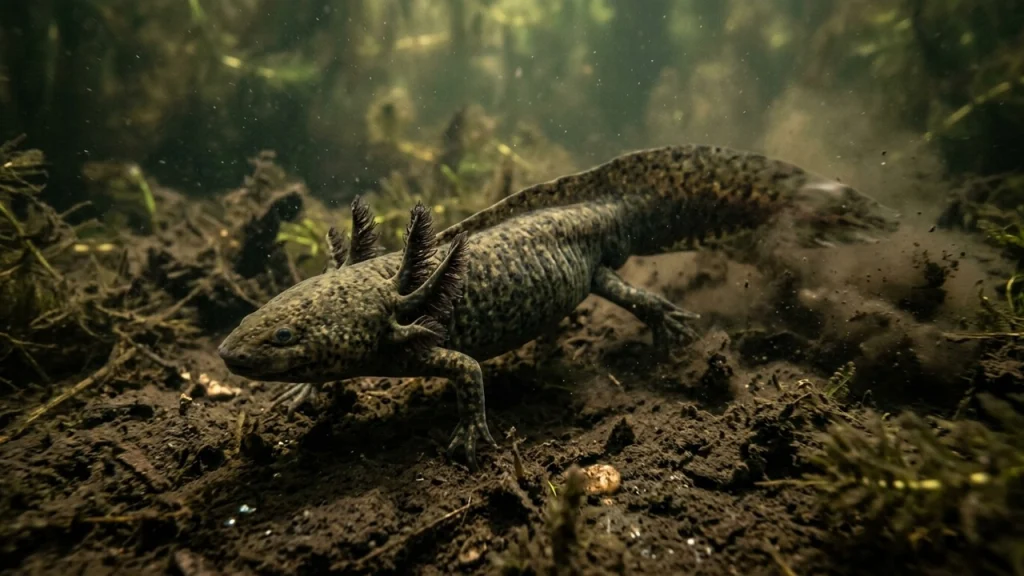
Although axolotls often drift placidly along lake substrates, their bodies conceal impressive athletic potential. When threatened by danger, an axolotl can burst forward at 10 miles per hour, equivalent to 15 kilometers per hour. A mature axolotl possesses an exceptionally light body mass, weighing roughly equivalent to a standard deck of cards. Individual specimens can attain up to 12 inches in total length, though standard growth typically averages about 9 inches.
To conceal themselves from predators and stalk prey in turbid channels, axolotls manipulate their appearance. Axolotls possess dark skin tones matching bottom silt and can adjust their color several shades lighter or darker for active camouflage. This shifting skin coloration blends seamlessly with decomposing vegetation, organic mud, and shadowed lake beds.
Their skeleton also incorporates surprising structural flexibility. Their internal skeletal framework remains largely non-osseous, with the wrists, ankles, and delicate gill support structures formed entirely of flexible cartilage. The spine comprises an average count of 50 vertebrae, with 30-35 located along the powerful tail. This flexible cartilaginous framework gives them swift maneuverability when flexing their bodies through thick underwater weeds.
Versatile respiratory pathways
Axolotls employ several complementary breathing techniques to sustain their cellular metabolism in varying aquatic conditions. Beyond external gill branches, mature axolotls possess functioning internal lungs and absorb oxygen across their permeable skin. Their prominent gill filaments flutter gently in the current, extracting dissolved oxygen directly from surrounding water.
When oxygen levels drop in warm, stagnant lake shallows, axolotls turn to atmospheric respiration. Larger individuals regularly swim toward the water surface to pull in an immediate gulp of fresh air. This multidimensional breathing apparatus ensures that axolotls maintain sufficient blood oxygenation regardless of shifting water chemistry.
Courtship rituals and rapid larval growth
The reproductive rituals of axolotls highlight intricate behavioral coordination between partners. During seasonal breeding, males track females through chemical pheromones and initiate an elaborate courtship hula routine. The male vigorously vibrates his posterior body and tail until the receptive female signals approval by touching his body with her snout.
Following this display, the male deposits approximately 25 sperm packets on the substrate each night and guides the female across them. The female retrieves these spermatophores into her cloaca to fertilize her developing clutch. The female anchors each fertilized egg separately onto aquatic vegetation or stones to protect her offspring against predatory fish.
Development unfolds with remarkable rapidity once the eggs are safely secured among underwater structures. Emerging larvae hatch roughly two weeks after laying and begin swimming independently without any form of parental care. Within an additional two weeks, newly hatched larvae develop sturdy hind limbs, transforming into fully formed miniature axolotls. These independent juveniles quickly master bottom hunting to sustain their vigorous development.
Native sanctuary and captive longevity
Axolotls naturally thrive as lentic specialists, requiring still-water lake environments rather than flowing rivers. Wild populations survive across only two freshwater habitats, Mexico’s Lake Xochimilco alongside Lake Chalco, where the species is Critically Endangered due to severe pollution, habitat degradation, and competitive non-native species.
Severe environmental degradation threatens their native range, where untreated wastewater and industrial pollutants from Mexico City degrade canal water. These combined pressures have sharply reduced breeding territory throughout southern urban waterways.
While wild specimens survive shorter lifespans, captive axolotls housed in clean environments have reached an impressive 25 years of age. Through coordinated habitat restoration, canal biofiltration projects, and dedicated zoo conservation programs, researchers strive to preserve these extraordinary amphibians so their legendary biological superpowers endure for future generations.
Sources
- San Diego Zoo Wildlife Alliance: Axolotl | San Diego Zoo Animals & Plants
- Animal Diversity Web: Ambystoma mexicanum (Salamandra ajolote) | INFORMATION | Animal Diversity Web
- National Geographic: Axolotl | National Geographic
- Toronto Zoo: Toronto Zoo | Axolotl
- PubMed Central: The axolotl limb blastema: cellular and molecular mechanisms driving blastema formation and limb regeneration in tetrapods