
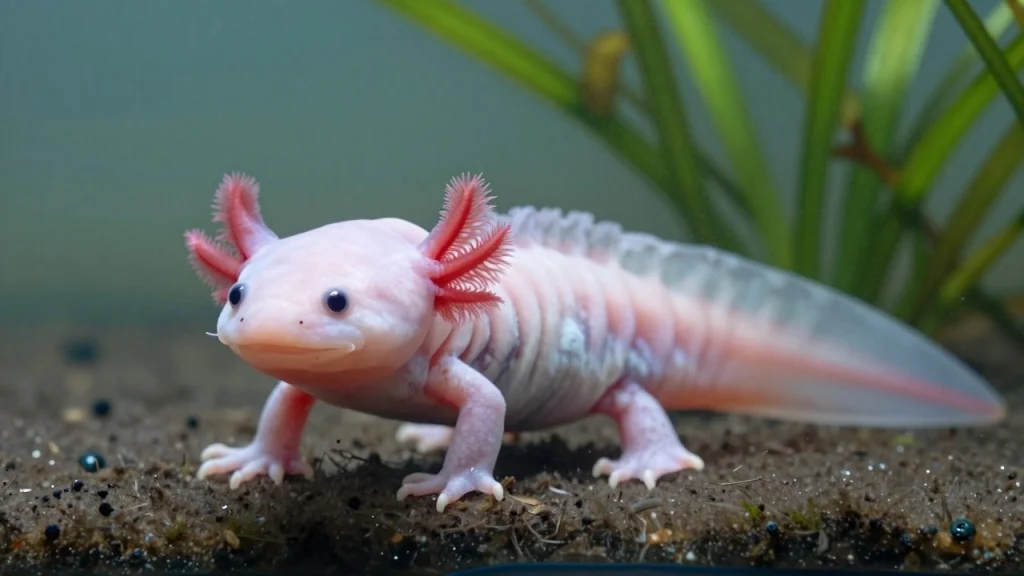
When pet owners ask whether an axolotl is intelligent, they often wonder if this aquatic salamander can learn tasks or recognize human faces. Axolotls do not show the complex cognition seen in mammals or birds. They are not known for abstract reasoning or problem-solving, and their solitary habits involve little social behavior. Instead, their central nervous system operates through ancient evolutionary reflexes tuned for solitary freshwater survival and predatory strikes.
This lack of mammalian cognition does not mean their brain is simple. To pinpoint targets without complex cognitive deliberation, these amphibians sense weak electrical currents while tracking chemical traces and visual markers in the water column. Rather than deliberating, their nervous system processes vital environmental inputs with high efficiency. Neurobiologists identify the salamander pallium as an evolutionary homologue to the cerebral cortex of mammals, with the medial pallium corresponding directly to the mammalian hippocampus. Understanding axolotl intelligence requires examining their neural architecture, sensory adaptations, and remarkable capacity for self-repair.
Forebrain anatomy and evolutionary structures
The central nervous system of an axolotl reflects millions of years of aquatic vertebrate development. The telencephalon constitutes the largest neural structure within the salamander head, containing the lateral ventricles along with both the pallium and subpallium across its forward division. Within this forebrain arrangement, specific regions process sensory feedback and coordinate motor activity. Paired pallial and subpallial regions establish the left and right cerebral hemispheres. Although lacking a folded neocortex, their forebrain shares ancient genetic roots with higher vertebrates.
Advanced sequencing reveals deep molecular similarities to mammalian neural tissue. Modern cellular sequencing confirms that multiple clusters of glutamatergic neurons situated in the medial pallium closely parallel the neurons derived from mammalian cortex and hippocampal tissues. These glutamatergic populations manage neurotransmission across the forebrain during environmental interactions. However, their structural organization reflects cold-blooded physiology. Histological examinations reveal an absence of myelin staining in the forward sectors of the nervous system, specifically throughout the telencephalon and olfactory bulb.
These ancient neural blueprints make the species an invaluable model for neurological research. Because of their unique nervous structure, axolotls serve as primary laboratory subjects in scientific investigations spanning neurobiology, embryonic growth, genetic regulation, and anatomical regeneration. By analyzing these amphibian circuits, researchers discover how vertebrate forebrains evolved to coordinate survival behaviors.
Sensory perception without cognitive reasoning
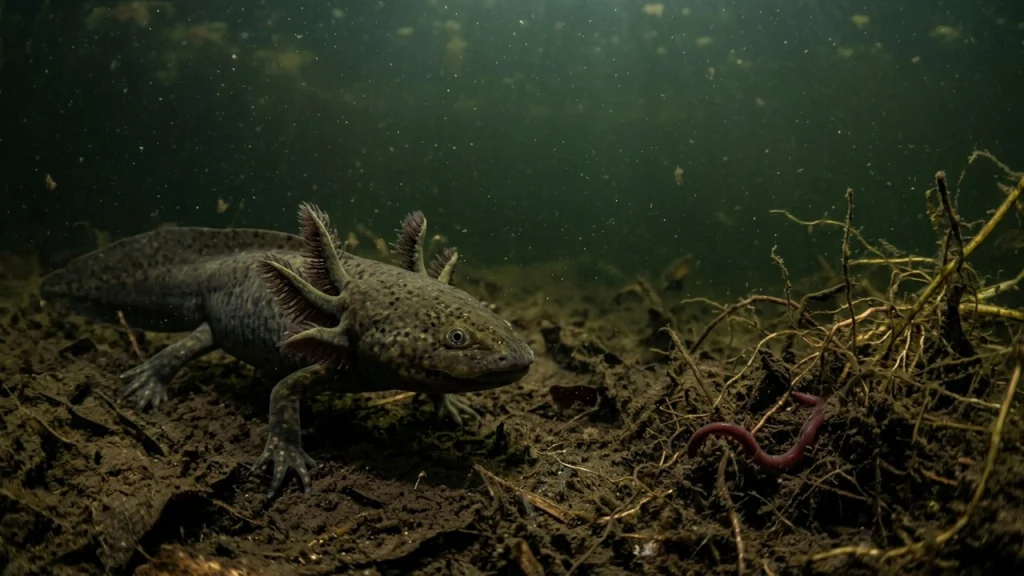
Rather than relying on conscious problem-solving, axolotls depend on sensory channels adapted to dark water. Natural populations exhibit lentic habitat specializations, settling permanently within calm, still-water basins. In these murky aquatic channels, eyesight plays only a supportive role. Circular dark eyes bordered by shimmering yellow irises scan dim water layers while four limbs push the amphibian along muddy bottoms. Their retinas primarily perceive movement and contrasting shadows.
Their ocular structure directly reflects their fully aquatic life cycle. Their eyes remain constantly exposed because axolotls possess no eyelids. Since they never emerge onto land, their eyes do not require protective covers or tear film. To locate prey in low visibility, skin receptors detect weak bioelectric currents from nearby invertebrates, allowing precise strikes without clear vision.
Their solitary behavior explains why advanced social intelligence never evolved in the species. Unlike social mammals that exhibit pack dynamics, axolotls live as solitary creatures that wake or rest at any hour of the day or night. They do not form social hierarchies or recognize individual conspecifics. Outside brief reproductive encounters, axolotls engage in virtually no communication with other members of their own species. When two adults meet, they interact only briefly if seasonal conditions stimulate breeding. When breeding arrives, adult pairs interact almost exclusively through chemical signals and subtle visual displays.
Instinctive hunting behavior and predatory tactics
In aquariums, axolotls often swim toward the glass when a person approaches, leading owners to assume their pet recognizes them. In truth, this reaction reflects simple associative conditioning rather than emotional attachment. Axolotls quickly connect surface disturbances and shadows with food delivery. Functioning as apex carnivores across their native habitat, axolotls consume any moving prey they intercept, including molluscs, fishes, arthropods, and smaller members of their own kind.
Their predatory strike relies on suction physics rather than physical chewing. Rather than chewing food, they deploy an explosive vacuum suction action to snap up passing aquatic worms, tadpoles, various insects, and small fish. By dropping the floor of their mouth and opening their gills, they create a sudden negative pressure pocket that pulls prey inside.
Their daily cycle balances hunting with hiding from potential predators. They burrow quietly into underwater mud and plant roots during daylight to evade detection, growing hungry and energetic after sunset. Although usually slow, they possess surprising athletic bursts. When startled by a sudden disturbance, axolotls can burst away at 10 miles per hour using powerful undulating sweeps of their flattened tail.
Their reproductive strategy relies on volume rather than parental guidance. A female deposits her clutch egg by egg across submerged stones and aquatic foliage so predators cannot devour them all at once. Once oviposition finishes, the adults abandon the clutch completely. Parents provide zero brood care, leaving newly emerged larvae to navigate early survival entirely on instinctive impulses. Young larvae must hunt tiny aquatic organisms immediately while dodging hungry adults.
Neurological regeneration and the brain-body axis
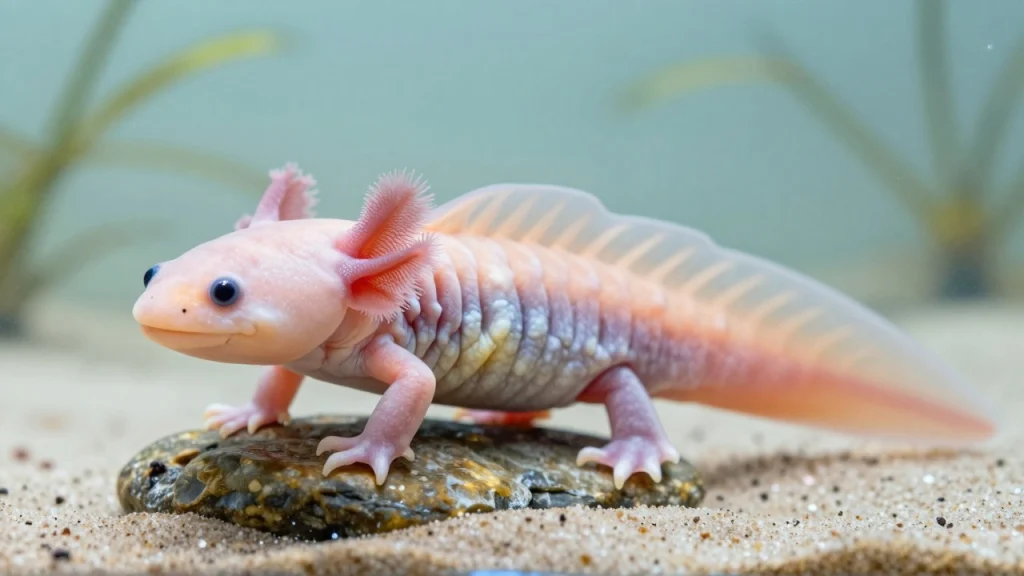
While axolotls lack advanced cognitive skills, they possess unmatched regenerative intelligence. In adult mammals, traumatic brain or spinal damage results in permanent scar tissue and lifelong functional deficits. Axolotls overcome this physical barrier through innate cellular repair. Mature salamanders demonstrate an unmatched capacity to regrow damaged spinal cord and brain regions, a restorative talent missing in adult anurans and other mature vertebrates.
When neural damage occurs, specialized ependymoglial cells activate, divide, and differentiate into mature neurons. Clinical examinations highlight their capacity to rebuild amputated tails, missing extremities, spinal segments, eye lenses, and areas within the heart and brain. These newborn cells integrate into surviving neural circuits without forming glial scars. The axolotl pallium holds exceptional biological interest because it can rebuild its structural fabric after severe physical trauma.
This restorative capacity establishes the species as a central model for neurobiology. As an animal model, Ambystoma mexicanum ranks among the exceedingly rare vertebrate creatures that can rebuild both brain tissue and spinal pathways following traumatic damage. Recent studies demonstrate that the brain actively directs full-body repair. Recent neurological research reveals an intricate brain-body signaling axis that orchestrates cellular regrowth at distant injury points across the body.
Following peripheral amputation, distant forebrain circuits trigger hormonal and neurochemical repair cascades. Specialized glutamatergic cells within the medial pallium sustain an active Erk molecular response that persists for up to ~40 days post-injury while governing distant tail regrowth. This prolonged molecular response communicates with the hypothalamus to support distant tissue formation. This ongoing coordination proves that the central nervous system manages a sophisticated balance between local wound cells and distant brain regions during full-body restoration.
Paedomorphic biology and wild conservation status
The axolotl brain is permanently linked to its unusual developmental pathway. Unlike other amphibians that metamorphose into terrestrial adults, axolotls remain fully aquatic throughout life. By exhibiting paedomorphic development, A. mexicanum keeps juvenile larval traits even after reaching full sexual maturity.
Their aquatic respiration relies on three distinct anatomical mechanisms:
- Prominent feathery gills sprout outward from three distinct stalks flanking either side of the skull.
- To absorb dissolved oxygen, these amphibians breathe simultaneously through cutaneous skin surfaces and external gill rami.
- In addition to facilitating respiratory gas exchange, the gills actively expel metabolic waste products from the bloodstream.
Their natural geographic distribution is exceptionally narrow. Historically, wild populations of Ambystoma mexicanum occupied only Lake Chalco and Lake Xochimilco within the Valley of Mexico near Mexico City, Mexico. In these still waters, axolotls develop into substantial salamanders. Mature specimens attain an overall length of 8 to 12 inches while reaching a body weight between 2 and 8 ounces. Axolotls reach their age of maturity at 6-8 months, survive for a captive lifespan of 10 to 15 years, and require a young gestation duration of 2 weeks before a clutch of 300 to 1,000 eggs begins development.
Their failure to metamorphose naturally results from low thyroid stimulating activity. Although wild individuals avoid transformation, laboratory technicians can induce complete metamorphosis by administering thyroid hormone injections. Such hormonal treatments cause the animal to resorb its gills, develop eyelids, and walk onto land.
In their native Mexican waters, axolotls face severe survival pressures. Because of relentless canal pollution and loss of habitat, the International Union for Conservation of Nature designates the wild amphibian as critically endangered. Introduced fish like carp and tilapia prey on eggs and larvae, pushing wild populations toward extinction.
When evaluating whether an axolotl is intelligent, science offers a clear distinction. They are not known for abstract reasoning, problem-solving or social behavior. However, their nervous system exhibits extraordinary sensory adaptation and tissue regeneration, proving that evolutionary success relies on biological specialization rather than brain size.
Sources
- Animal Diversity Web: Ambystoma mexicanum (Salamandra ajolote)
- San Diego Zoo Wildlife Alliance: Axolotl | San Diego Zoo Animals & Plants
- Point Defiance Zoo & Aquarium: Examining an Axolotl – Point Defiance Zoo & Aquarium
- Scientific Reports: MRI- and histologically derived neuroanatomical atlas of the Ambystoma mexicanum (axolotl)
- npj Regenerative Medicine: Neuronal activation in the axolotl brain promotes tail regeneration