
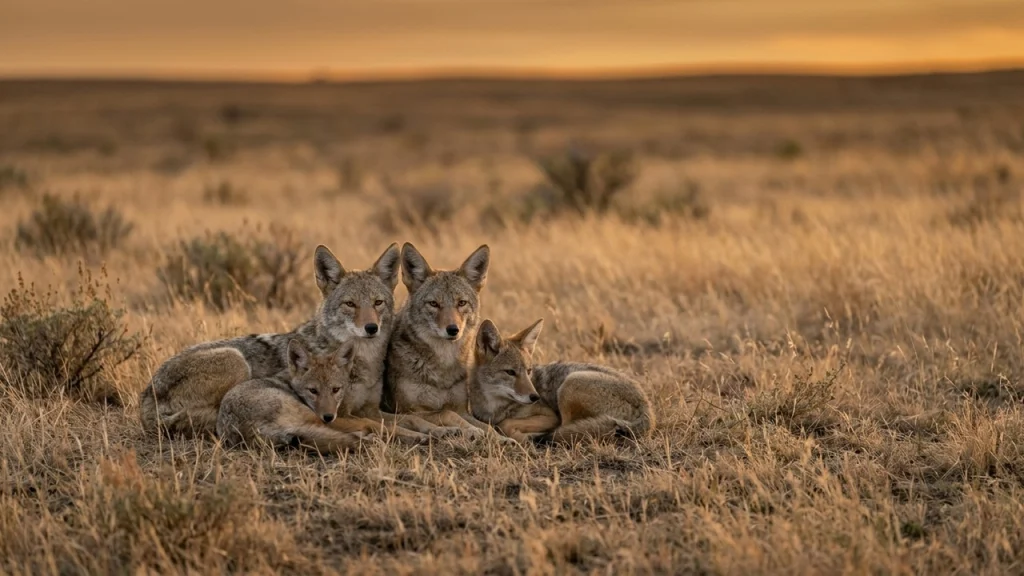
Many outdoor observers wonder: do coyotes live in packs? The straightforward answer is that coyotes frequently live in family groups, but their social lifestyle differs sharply from the large, obligate packs seen in wolves. Field biologists observe that coyotes remain deeply social canids that organize their daily lives around stable family groups rather than massive aggregations. Compared to gray wolves, coyotes show a far lower tendency to assemble into permanent communal packs.
Instead of traveling in giant groups, coyotes maintain high flexibility in how they interact and hunt. Individual members typically travel and search for food alone, though cooperative pairs occasionally unite to pursue evasive targets. While solitary foraging remains standard, these canids construct durable family units and can also assemble into aggregations of unrelated animals described as packs. This adaptable social system balances independent hunting with cooperative family defense.
The monogamous core of the coyote pack
At the heart of every true coyote group stands a dedicated pair bond. Lifelong fidelity remains exceptionally rare across the animal kingdom, appearing in only about 3 to 5% of mammals. Coyotes form enduring, lifelong partnerships.
Research confirmed that coyotes practice strict monogamy by pairing with a single reproductive partner throughout their entire existence. A breeding male and female bond together and preserve their mutual partnership across several consecutive years.
This fidelity persists even under high population density and heavy human disruption. Long-term telemetry in the metropolitan Chicagoland area confirmed that urban coyotes remain loyal to their original partners indefinitely, rejecting opportunities to mate with neighboring canids. A coyote leaves its established companion only when that partner dies.
Annual breeding and social hierarchy
Coyote social structure operates on strict reproductive discipline overseen by the alpha pair. Canid physiology limits coyote reproduction to a single annual opportunity each calendar season.
Courtship and successful breeding occur exclusively between January and March. Dominant alpha pairs forcefully defend their partners from external suitors during courtship, actively preventing reproductive activity among lower-ranking subordinates residing within the group.
Preserving unbroken social structures helps secure overall territorial stability across neighboring canid populations.
Raising pups and generational pack growth
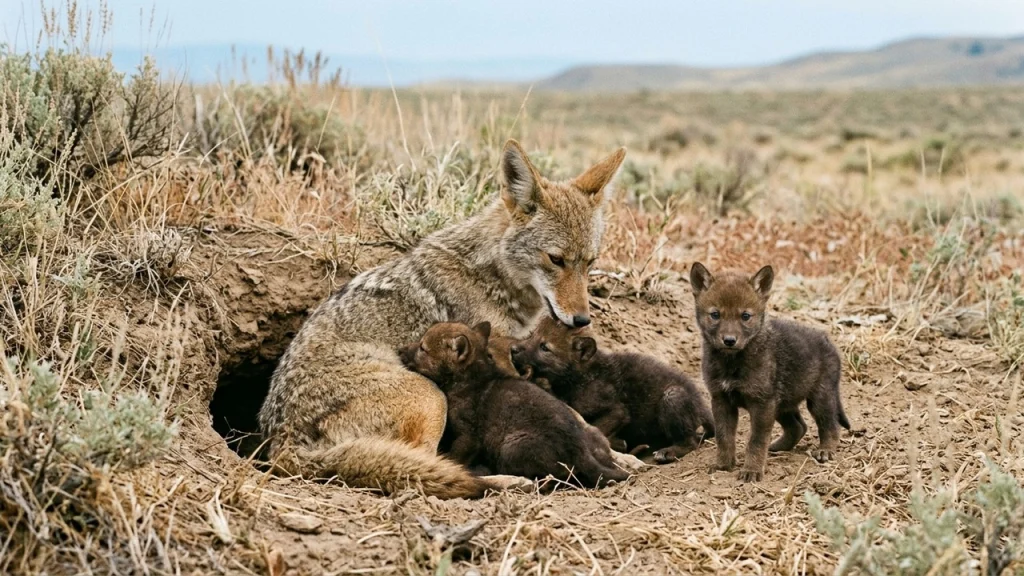
Pack formation begins anew in the spring nursery den. Following springtime births, an average litter produces five to seven pups.
Newborn pups gain their sight after 10 days and venture away from the nursery shelter upon reaching eight to 10 weeks old. Juvenile offspring often remain alongside their parents well into adulthood, developing hunting competencies through prolonged observational learning.
As juveniles mature, their roles within the family group diverge based on sex and local opportunities:
- Dispersing males: Young males typically migrate away from natal homes between months 6 and 9, whereas maturing females tend to stay with parents to anchor the pack’s generational core.
Resident territories and solitary transients
Coyote landscapes divide into two distinct social classes: territorial residents and solitary floaters. Defending home terrain demands constant vigilance from both partners throughout all seasons, allowing established pairs who collaborate across summer and fall to secure prime conditions for future breeding.
Established resident territories reach an upper boundary around 47 km 2, while individuals displaying wandering movements exceeding >65 km 2 represent nomadic transients.
Telemetry studies demonstrate that transients act as subordinate roamers who skirt established pack borders and survive in marginal spaces left vacant by dominant residents. These unattached nomads avoid confrontations with resident packs, yet they fulfill an essential ecological replacement function across regional populations.
Whenever a breeding resident perishes, nomadic floaters regularly step in to fill the vacancy. Widowed territorial holders temporarily admit several opposite-sex roamers across their boundaries to evaluate and choose an acceptable successor. After securing a new reproductive partner, the resident immediately reestablishes strict territorial closure against all outside intruders.
Cooperative hunting and seasonal teamwork
Coyote group dynamics often dictate dietary success and foraging methods. Foraging strategies around the den shift between solitary stalks, pair efforts, and family units according to prey abundance.
Tackling larger ungulates such as deer demands coordinated group teamwork. Collaborating canids either alternate chase relays until their quarry collapses from exhaustion or steer fleeing prey straight toward concealed pack members.
Pack members also mount sophisticated ambushes against agile mountain herbivores. Coordinated packs have been documented driving bighorn sheep up steep hillsides toward awaiting ambushers ready to capture vulnerable animals. Such strategic coordination proves that coyotes can function as highly cooperative pack predators when ecological conditions favor group hunting.
Vocal communication and pack cohesion
Maintaining social bonds across extensive landscapes requires sophisticated communication. Vocal howls broadcast geographic positions to scattered pack companions across the landscape.
Pack members also vocalize when reuniting after separations and to clarify their immediate positions to one another. Auditory displays also serve to signal territorial boundaries directly to rival packs.
Physical characteristics and field identification
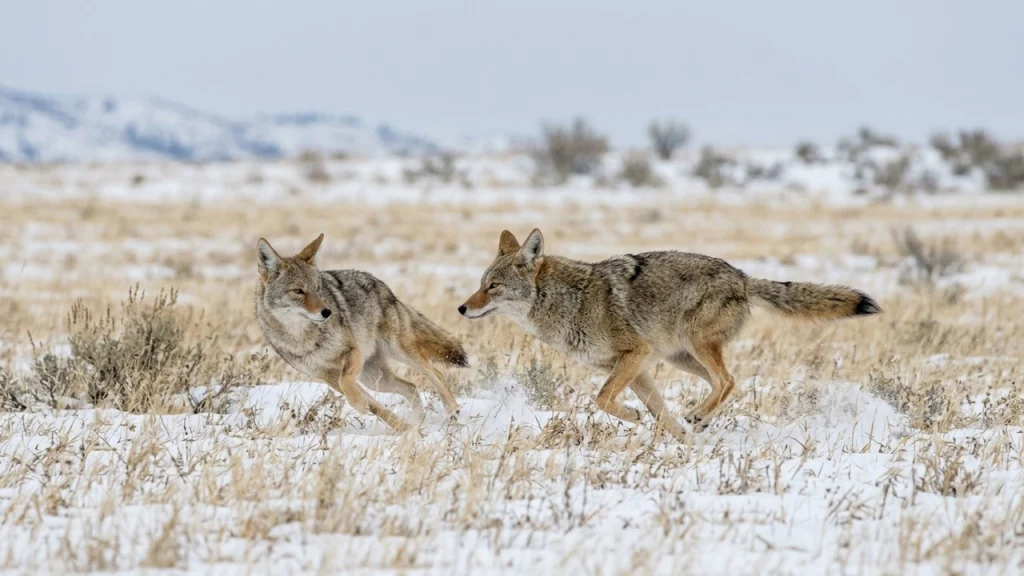
Field identification often reveals the solitary or social nature of wild canids. Running postures reveal clear taxonomic differences, as domestic canines hold tails aloft, wolves carry tails straight outward, and sprinting coyotes carry their tails pointed downward. This distinctive tail posture offers immediate visual confirmation during field observations.
Adult body dimensions span three to four feet in total length and weigh between 20 to 50 pounds. Athletic bursts enable canids to reach top speeds reaching 65 km/hr alongside leaping spans measuring 4 m. These physical adaptations empower coyotes to thrive whether living alone, hunting in pairs, or cooperating within complex family packs.
Sources
- Animal Diversity Web: Canis latrans (coyote)
- National Park Service: Coyote – Rocky Mountain National Park
- National Park Service: The Coyote
- National Geographic: Coyotes mate for life, and grieve when their partner dies
- PLOS: Space Use and Habitat Selection by Resident and Transient Coyotes (Canis latrans)
- Elsevier: Integrity of mating behaviors and seasonal reproduction in coyotes (Canis latrans) following treatment with estradiol benzoate