
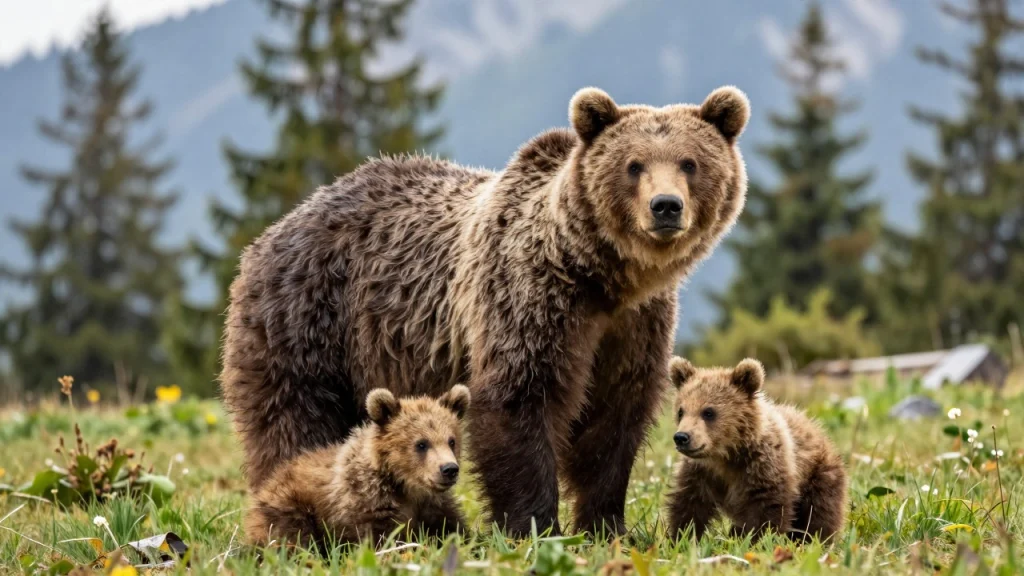
Bear cubs remain dependent on their mothers for about one and a half to three years in most species, and brown bear cubs can stay even longer, primarily because they require an extended period to learn complex survival skills, gain physical mass, and receive critical protection from predators. Unlike many bovid young, which can stand and run within an hour of birth, bear cubs are born with their eyes and ears closed, and are naked or have only a thin coat of fur, inside a winter den. This long maternal care window ensures they transition successfully from fragile neonates to capable adult predators.
During this extended dependency period, the mother bear provides total nourishment, protection from infanticidal male bears and other predators, and crucial hands-on training. Cubs learn essential behaviors such as finding seasonal food sources, hunting, digging winter dens, and navigating competitive wildlife landscapes. Without this prolonged stay with their mother, young bears would lack the knowledge and physical development necessary to survive independently in the wild.
Birth in the Den and Early Physical Development
Bear reproduction involves a physiological process called delayed implantation, where fertilized eggs do not implant in the uterus until the mother has accumulated sufficient fat reserves for hibernation. Cubs are typically born during mid-winter dormancy (American black bears and brown bears mainly in January or February, polar bears as early as November), weighing anywhere from about 90 grams in giant pandas to 680 grams in brown bears, with polar bear cubs around 600 grams. At this stage, they are entirely dependent on their mother’s milk, which is exceptionally rich in fats and protein.
Throughout the remaining winter months, cubs nurse and grow rapidly inside the insulated environment of the den. By early spring, when the mother emerges from hibernation, the cubs have developed fur, opened their eyes, and gained enough strength to follow her outside. However, despite their rapid initial growth, their bodies take years to reach adult size: females usually by about age 5, males not until 10 to 11 years.
Timeline of Bear Cub Development:
├── Birth (Mid-Winter): ~90 - 680 g (species-dependent), blind, hairless, fully den-bound
├── Spring Emergence: ~10 - 15 lbs, mobile, begins exploring outside den
├── Year 1 (First Summer/Fall): Foraging lessons, social learning, weight gain
├── Year 2 (Second Winter/Summer): Advanced skills, predator avoidance, growth
└── Year 2.5 - 3 (Weaning/Dispersal): Full independence, mother prepares to mate
Learning Essential Foraging and Hunting Skills
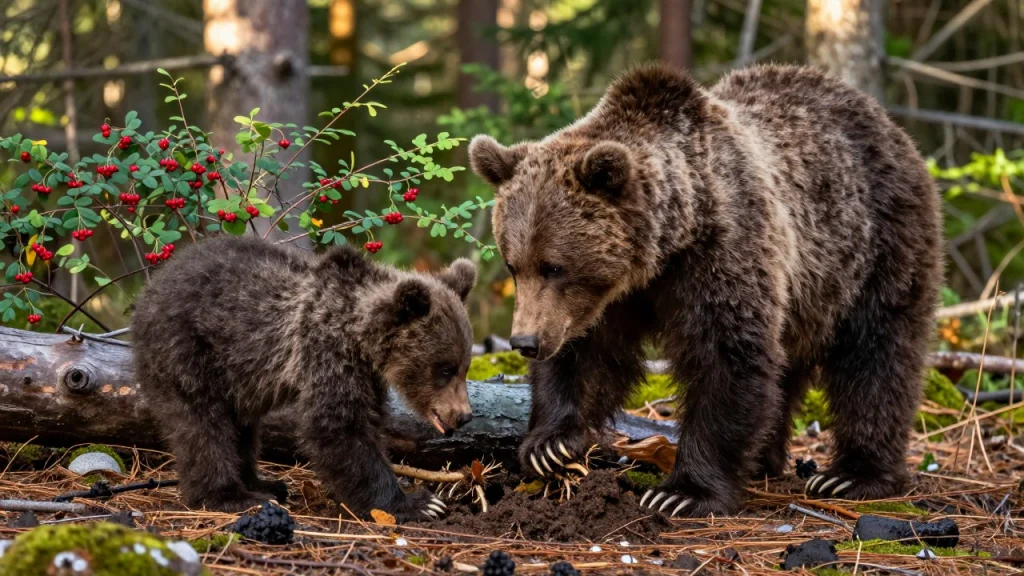
One of the main reasons bear cubs stay with their mother for so long is the sheer complexity of the bear diet. Bears are omnivores with intricate foraging strategies that vary dramatically by season and habitat. Learning what to eat, where to find it, and when it is available requires years of direct observation and practice.
Mother bears teach their offspring how to navigate vast home ranges to exploit seasonal food blooms. Cubs learn to identify edible plants, dig up calorie-rich roots, harvest berries, and locate insect larvae under decaying logs. In regions with salmon runs or ungulate populations, cubs observe and practice sophisticated hunting and fishing techniques under maternal guidance.
- Identifying seasonal plants and berries: Learning which vegetation is nutritious during spring, summer, and autumn.
- Mastering hunting and fishing methods: Stalking small mammals, catching spawning fish, or scavenging carcasses efficiently.
- Digging and foraging mechanics: Utilizing powerful claws to unearth tubers, roots, and underground insect colonies.
- Locating water and mineral sources: Memorizing reliable water points across extensive seasonal territories.
Protection Against Predators and Male Bears
Wild environments present continuous threats to young bears. Wolves, mountain lions, other bears, and other large predators pose a threat to vulnerable cubs. Furthermore, adult male bears, called boars in brown bears, pose a threat: male polar bears, for instance, may prey on cubs when they make contact. During mating season, male bears may attempt to kill cubs to induce estrus in the female, a behavior known as sexually selected infanticide.
The presence of an aggressive, protective mother is the cubs’ strongest defense against these threats. Mother bears will fiercely defend their young against much larger rivals, often driving off threats or treeing their cubs while confronting danger on the ground. The protective umbrella of the mother gives cubs the safety needed to reach an age and size where they can defend themselves.
Den Building and Hibernation Knowledge
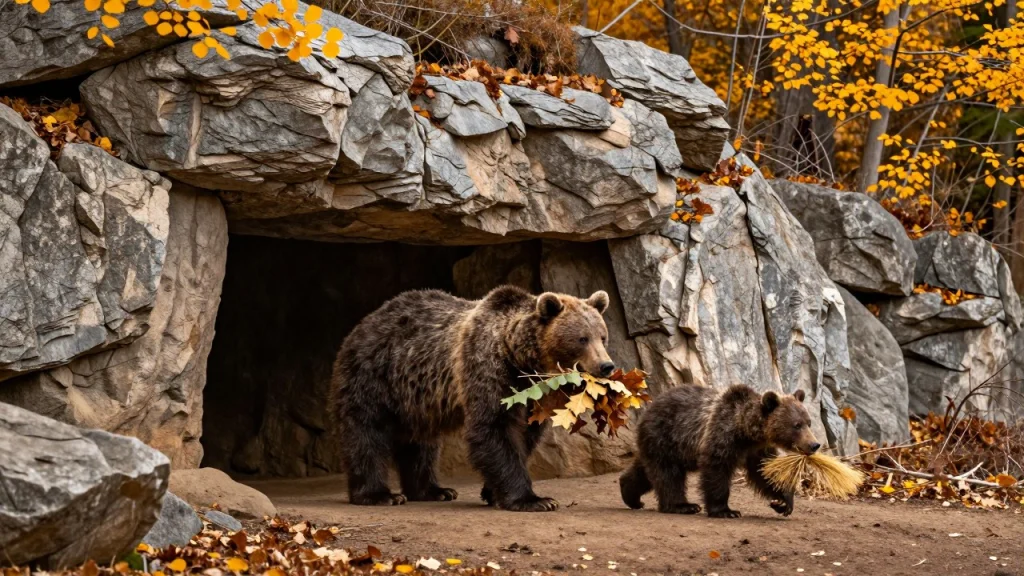
Hibernation is a crucial survival mechanism for bears living in environments with harsh winters and seasonal food scarcity. Preparing for and surviving hibernation is not entirely instinctive; it involves learned behaviors handed down through maternal guidance. Black bear cubs den with their mother through their second winter, until about 17 months old, learning how to select secure locations and construct winter shelters.
Cubs observe how their mother selects suitable den sites (such as hollow trees, rock crevices, or excavated hillsides) and how she lines the interior with dry vegetation for insulation. They also experience the hyperphagia phase alongside her, learning to consume massive quantities of calories during late summer and autumn to build necessary fat stores before winter sets in.
Seasonal Hibernation Cycle:
[Spring Emergence] ──> [Summer Foraging] ──> [Autumn Hyperphagia] ──> [Winter Denning]
         │                                                                   │
         └────────────────── Mother Guides Cubs Through Cycle ────────────────┘
The Process of Weaning and Separation
The exact duration of maternal care varies by bear species and geographic location. For instance, American black bear cubs typically remain with their mother for about 1.5 years, dispersing during their second summer. In contrast, brown bears (grizzlies are one subspecies) keep their cubs for 2 to 6 years depending on subspecies, while polar bears keep theirs for 2 to 3 years.
Separation usually occurs when the mother enters her next reproductive cycle. As her hormone levels change in late spring or early summer, she becomes less tolerant of her offspring and eventually drives them away. By this time, young bears possess the physical size, foraging knowledge, and self-defense skills required to establish their own territories and survive independently.
Conclusion
The extended period bear cubs spend with their mother is a vital evolutionary strategy tailored to their complex ecological niche. Because bears rely heavily on learned behaviors, spatial memory, and physical size rather than pure instinct, spending years under maternal care ensures that young bears transition into self-sufficient, resilient adults capable of thriving in wild ecosystems.
Sources
- Animal Diversity Web, University of Michigan: Ursidae (bears) | INFORMATION | Animal Diversity Web
- Animal Diversity Web, University of Michigan: Bovidae (antelopes, cattle, gazelles, goats, sheep, and relatives) | INFORMATION | Animal Diversity Web
- Animal Diversity Web, University of Michigan: Ursus americanus (American black bear) | INFORMATION | Animal Diversity Web
- Animal Diversity Web, University of Michigan: Ursus maritimus (polar bear) | INFORMATION | Animal Diversity Web
- San Diego Zoo Wildlife Alliance: Brown Bear | San Diego Zoo Animals & Plants