
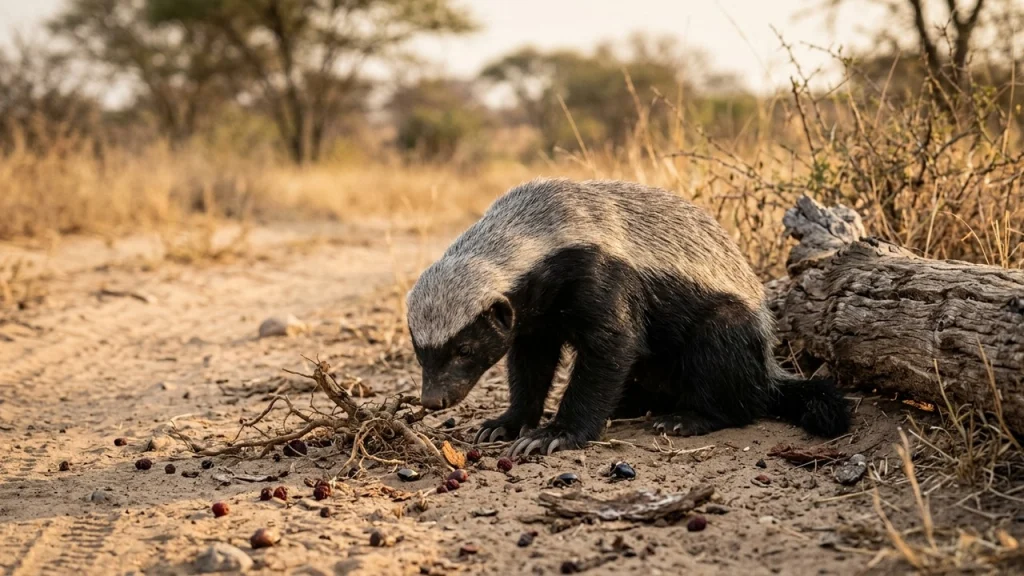
The honey badger, scientifically called Mellivora capensis, gathers nourishment from both animal and plant sources, a dual habit that shapes every part of its foraging life. Biologists therefore list the ratel as an omnivore, a classification that signals variety rather than specialization and frames the feeding details explained below, from hive raids to seasonal hunts.
Its popular name points to a marked liking for honey together with the soft grubs found alongside it, a craving that gave the animal its familiar English title. In truth, the immature insects inside the comb, not the sweet store itself, form the real prize during a hive raid, which is why raiders persist even when bees swarm around them.
Across regions the species feeds flexibly, adjusting its intake as local prey rises and falls through the year, so researchers treat abundance cycles as the main driver of menu change. The animal shares a broad family with otters, skunks, ferrets and fellow badgers, relatives whose generalist appetites help explain its own refusal to be fussy.
Why hives built a reputation
Honey itself ranks as an apparent favorite rather than the everyday staple, a nuance that keeps the English name charming but slightly misleading about true priorities. Exceptionally thick hide also blunts bee stings, porcupine quills and dog bites, armor that matters both at the hive entrance and during a confrontation.
That sweet tooth can anger apiary owners, some of whom kill visitors to defend hives, a clash that shows how food preferences translate directly into survival risks.
Meat leads the menu
Flesh still rules the table, with routine catches including frogs, snakes, eggs, birds and small rodents, a lineup that keeps protein at the center of daily energy budgets. Keepers describe an appetite stretching from small mammals, even the offspring of larger mammals, through birds and reptiles toward carrion, a span that lets one individual exploit burrows, nests and open ground within a single foraging trip.
Kalahari work recorded captured items spanning 2 to 2000 g, a spread that shows one predator handling both morsel-sized bites and weighty hauls without changing its basic tactics. When small-mammal numbers peaked from September to December, those animals filled 80% of intake, turning burrow hunting into the most profitable tactic for those months.
During the hot and wet interval from January to April, large snakes supplied 58% of the diet, so reptile tracking replaced rodent digging as the key skill for the season. Adult males averaged 1.3 kg of food per day, but female intake averaged 0.9 kg daily, a gap that reflects differing energy needs without changing the kinds of food each sex seeks.
Small mammals, serpents and insects on record
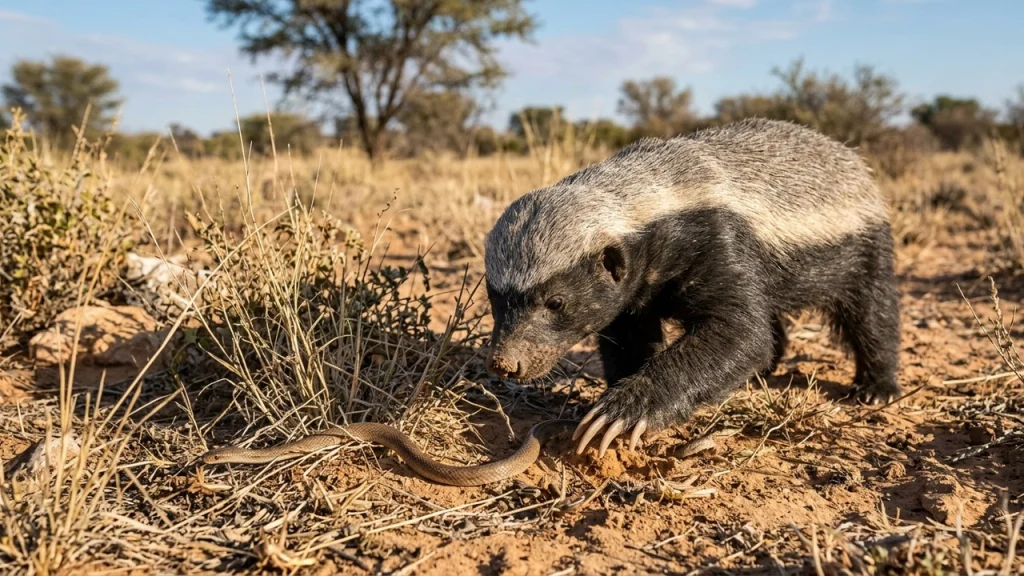
- Springhares and Brant’s gerbils stand out among the small mammals taken in the Kgalagadi, showing how open-country rodents anchor the menu when their numbers are high.
- Puff adders, Cape cobras and horned adders illustrate the serpent share, confirming that dangerous reptiles become routine prey rather than hazards to avoid.
- Yellow scorpions, termites and beetles round out the invertebrate share, prey that can be dug from soil and mounds rather than chased across open ground.
Plants, carrion and stolen meals
Plant support comes from bulbs, fruits, roots and berries, while insects add a further steady supply, together providing reserves that carry the animal through failed hunts. When fresh prey runs short, dead flesh becomes an accepted backup, allowing feeding to continue through lean spells that would starve a pickier hunter.
Although they catch most meals themselves, they readily rob fellow predators or finish remains left by larger hunters, an opportunistic streak that saves energy whenever kills lie available. Such breadth leads ecologists to reject any narrow-feeder label for the species, since dependence on a single food would contradict the constant switching seen in the field.
Meals in human care differ in form, not spirit
Captive menus center on prepared carnivore rations with mice, mealworms and crickets alongside, meals that mirror the protein-heavy wild pattern in a controlled setting. A weekly bone for chewing, fruit servings on hot days with honeydew as a favorite, plus an appreciated scoop of honey, complete the captive routine.
Built to dig, bite and brave stings
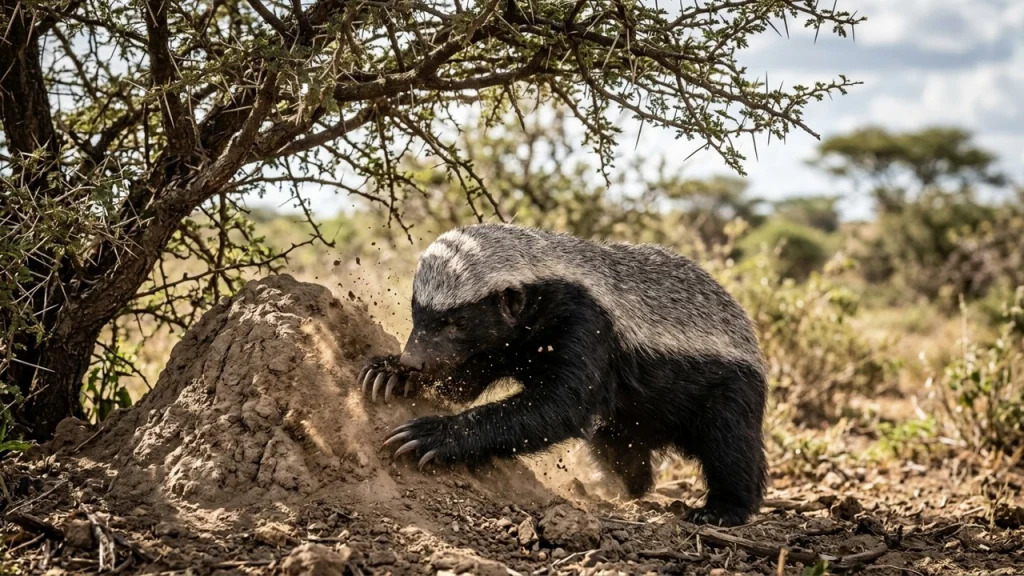
The habit of taking many venomous serpents points to special bodily adjustments for that risky food, since ordinary predators would pay a high price for identical bites. Zoo specialists likewise describe the species as apparently resistant to serpent venom, a trait that converts a lethal defense into a minor obstacle during the hunt.
Prominent teeth, lengthened front claws and a compact frame let them strip flesh from bone with ease, so little edible tissue stays attached once feeding begins. Those lengthened front claws double as digging tools and defensive weapons, letting the animal open soil and confront threats with the same equipment.
Strong swimming and tree climbing widen the hunting grounds, opening water edges and branches that purely ground-bound foragers cannot reach.
Solitary adults, dependent young
Most individuals live alone within loose, overlapping territories and sometimes converge where food is plentiful, a pattern that limits competition while still sharing rich patches. Mothers supply every meal across the opening 10 to 12 months of a cub’s life, a long apprenticeship funded entirely by her catches.
Size, lifespan and living space
Adults typically weigh 13 to 30 pounds, a stocky mass that supports forceful digging and the fierce self-defense for which the species is famous. Free-living animals often survive up to 7 years in nature, which frames the number of feeding seasons available to each generation in the wild.
Under expert care, longevity can reach up to 26 years, a contrast that shows how shelter and medical attention extend life well beyond wild limits. Mainly creatures of dry country, they also occupy forests and grasslands, habitats whose different prey communities reward exactly the flexible menu described above.