
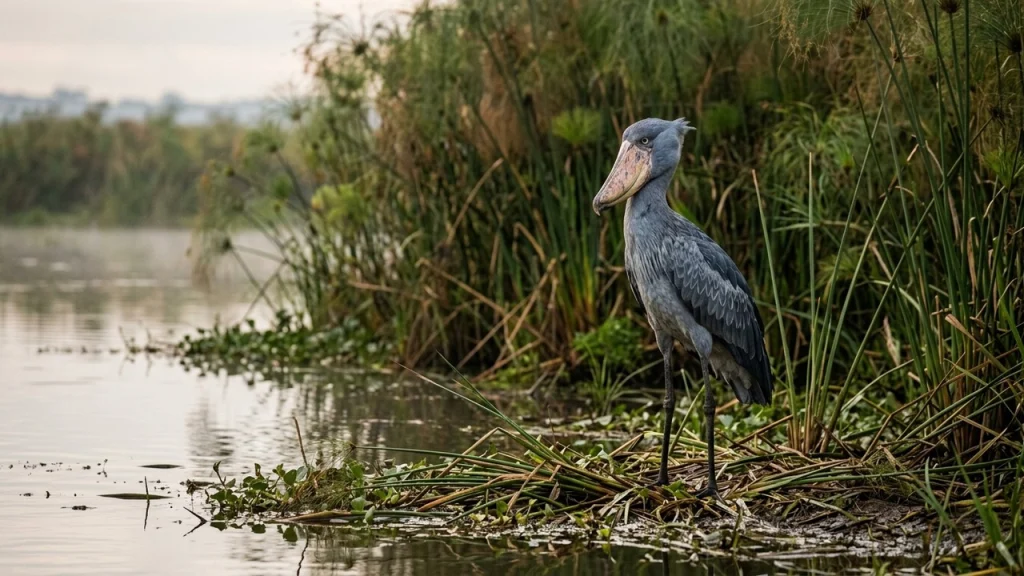
Seeing a shoebill in the wild is a genuine bucket-list event, and the odds have little to do with luck. The species is classed as Vulnerable by the IUCN, the most recent published estimate puts the whole population at 5000 to 8000 birds, and the adult birds alone are put at between 3,300 and 5,300. Those thousands of adults are spread thinly across a patchy range, and the bird itself is built to be overlooked.
Your odds are much better in a zoo than in a reed bed. Only a few zoos keep shoebills, while the wild birds are packed into a thin belt of freshwater swamp in central-eastern Africa. A zoo visit is therefore the realistic way to see one, and a wild encounter takes a specialist itinerary and a great deal of waiting.
Why the wild population is so hard to count
Counting shoebills is difficult by design: the bird is cryptic and lives in places people cannot easily reach, so the global estimate carries a wide margin of error. Almost no individuals have ever been ringed, and the species had never been tracked before a project that fitted GPS transmitters to six immature birds and one adult over a 5-year period in the Bangweulu Wetlands of Zambia.
Even the best studied stronghold rests on thin data. Bangweulu holds the southernmost shoebill population, and researchers say its size is largely unknown. A first census there in 1984 put the number at 200 to 300 birds, and a later survey produced an estimate of 1296, built on very few sightings and carrying a confidence interval from 477 to 2372. Those numbers swing widely in part because much of the wetland was never surveyed.
Where the birds actually concentrate
The range is patchy rather than continuous, running from South Sudan to Zambia. The strongholds are the White Nile Sudd in southern Sudan, the wetlands of northern Uganda, western Tanzania and Zambia’s northeastern Bangweulu swamp. The bird’s distribution lines up almost exactly with papyrus and lungfish, which sums up the habitat requirement: permanent freshwater swamp with dense, undisturbed stands of reed. In deeper water the bird needs a floating platform of vegetation to hunt from. Where the water is poorly oxygenated, fish surface for air more often, and that is the hunting opportunity it wants.
Shoebills are generally thought of as sedentary birds that stay in one region all year, although some individuals shift seasonally between nesting sites and feeding grounds. Each individual needs a great deal of room. Tracked birds covered an annual home range of around 1500 km2 on average, larger than that of comparable stork species, with individual adults ranging from 304 to 3375 km2. A bird can therefore be present in a place you walked through last week and still never cross your path.
The reason you walk past one without noticing
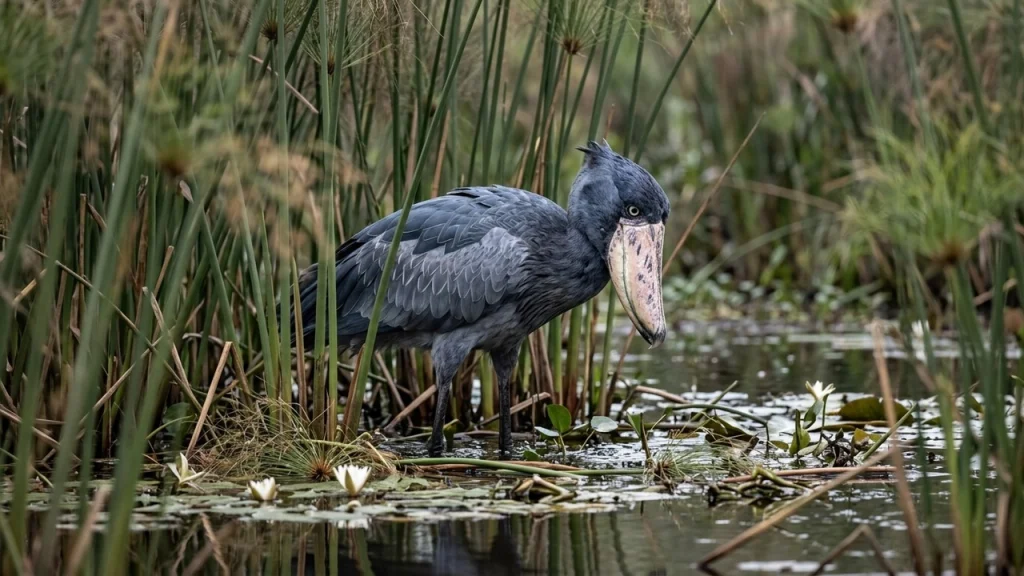
Shoebills are ambush hunters built for stillness. They wait motionless and silent in or beside water until the moment is right, then lunge forward with their wings spread and plunge bill-first onto a fish. The strike is so violent that the bill and the thick skull work as shock absorbers, yet the whole lunge takes only seconds. Males are bigger than females and carry longer bills, and a breeding pair feeds at opposite ends of the same territory rather than sharing a patch of water.
The bird is in no hurry to leave. It weighs no more than 16 pounds and flaps its wings only about 150 times per minute, among the slowest rates recorded for any bird. Tracking data make the point: tracked birds in the Bangweulu Wetlands covered less than 3 km on 81% of days, and through the breeding season adults stay near the nest.
Solitariness is the other half of the problem. Shoebills are never found in groups, and they only forage near one another when food runs short, with solitary breeding pairs holding territories of roughly 3 square kilometers. Adults also keep cool with gular-fluttering, so standing still takes up a large share of a shoebill’s daily life.
Zookeeping is the dependable sighting
San Diego Zoo Wildlife Alliance is blunt about it: shoebills can be seen at only a few zoos, the San Diego Zoo Safari Park among them, and Houston Zoo is another that keeps them. Captive breeding is the bottleneck, with hardly any accounts of it, and any young that do hatch tend to imprint on their keepers and then fail to breed once they are grown.
Zoo demand pushes the other way. Animal Diversity Web reports that demand runs very high, that the birds have fetched US $10,000 to $20,000 as the most expensive in that trade, and that this encourages local people to capture wild birds, cutting into the wild population. Tourism cuts the other way, since the birds earn money for local people whenever visitors take river excursions in Africa to look at wildlife.
What a shoebill actually looks like
The bird stands 110 to 140 cm tall, with a slaty blue-grey body, a darker grey head and black-tipped wing feathers. A wingspan of almost eight feet makes it read as far bigger in the reeds than its body suggests. The bill is the headline feature, running to nine inches in length and four inches in width, and it works as both trap and weapon at once.
A bill built like a trap
That huge structure is not decoration. The bird uses it to scoop up big fish, stab them with a pointed hook at the tip and cut the heads off along razor-sharp edges before swallowing.
What a shoebill eats
- Lungfish, the favorite prey, with individuals reaching six feet in length and weighing nearly eight pounds
- Bichirs, catfish, tilapia and water snakes, which join lungfish in the bulk of the regular diet
- Eels, frogs, monitor lizards and turtles, taken occasionally
- Young crocodiles, mollusks and carrion, recorded but rare in the diet
Shoebills spend most of the day foraging in water, and they are mostly quiet birds. They clatter their bills as a greeting and while nesting, and hungry chicks make hiccup-like sounds. The bird sits in a family of its own, and although it was once classified as a stork, its closest relatives are pelicans.
Why the numbers keep sliding
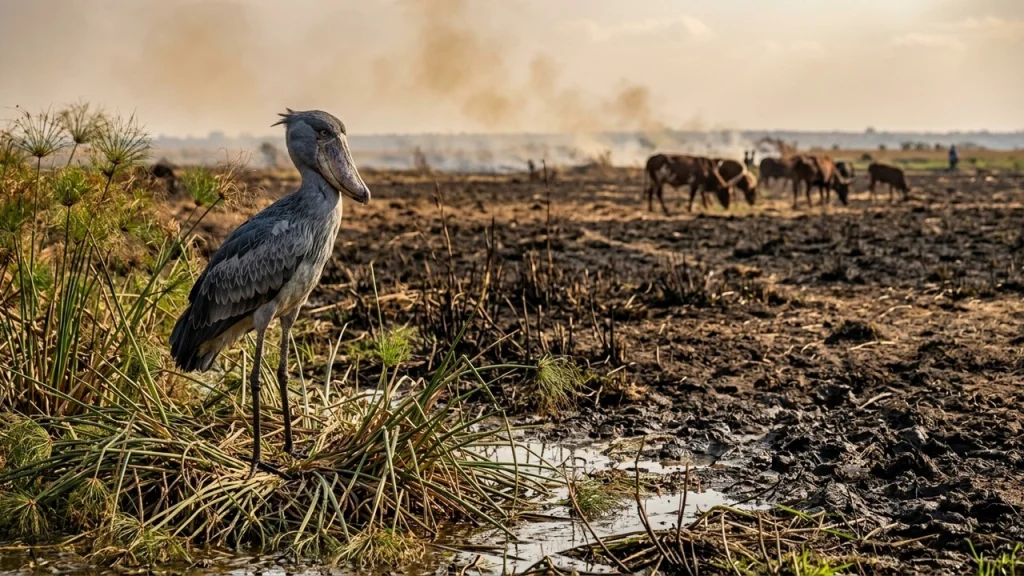
The conservation category is not the whole story, because the population trend is downward. Researchers attribute the decline to the loss and degradation of habitat, to illegal bird trade and to disturbance by humans. Clearing land for pasture counts as a major threat, and cattle sometimes trample nests outright. The swamps also suffer from crop-field burning and from pollution linked to the oil industry and tanneries. In some places the birds are hunted for food, while elsewhere they are killed on the grounds that they are a bad omen.
Animal Diversity Web names habitat destruction as the greatest threat and notes that these swamps and marshes are rapidly becoming farmland and cattle grazing grounds, while fishermen disturb the birds’ feeding areas.
Legal protection, folklore and a bird worth protecting
Protection reaches a long way. The species is listed in Appendix II of CITES and protected by law in Sudan, the Central African Republic, Uganda, Rwanda, Zaire and Zambia. It also carries a cultural shield: folklore protects shoebills, and communities are taught to respect and to fear them.
Nests are not safe, though. Adults have few predators, but eggs and chicks can be taken by nest predators, and the birds answer by building where few predators can reach and by defending their young aggressively. They are themselves key predators in the marshes and swamps they inhabit, so a healthy shoebill population is a fair measure of what those wetlands still produce.
What one sighting tells you
A wild shoebill is a mature adult, since birds reach maturity only at three to four years of age, and a wild bird that survives can live to almost 36 years. Breeding pairs are monogamous, a female averages two eggs, laid near the end of the wet season, and the eggs hatch in about a month. Nests are built on floating vegetation, which by the close of the breeding season is resting on solid ground, and both parents take turns incubating and cooling the eggs with water carried in their large bills.
Then the arithmetic narrows. Usually only one chick fledges from a clutch averaging two eggs, so a pair that loses a bird to hunting or a lost swamp cannot be replaced quickly. That is why seeing a single adult in a working marsh is a better sign than it first appears. The wetland still floods seasonally, the papyrus still stands undisturbed, the fish still come up to breathe, and the bird that depends on all of it is still there to be watched.