
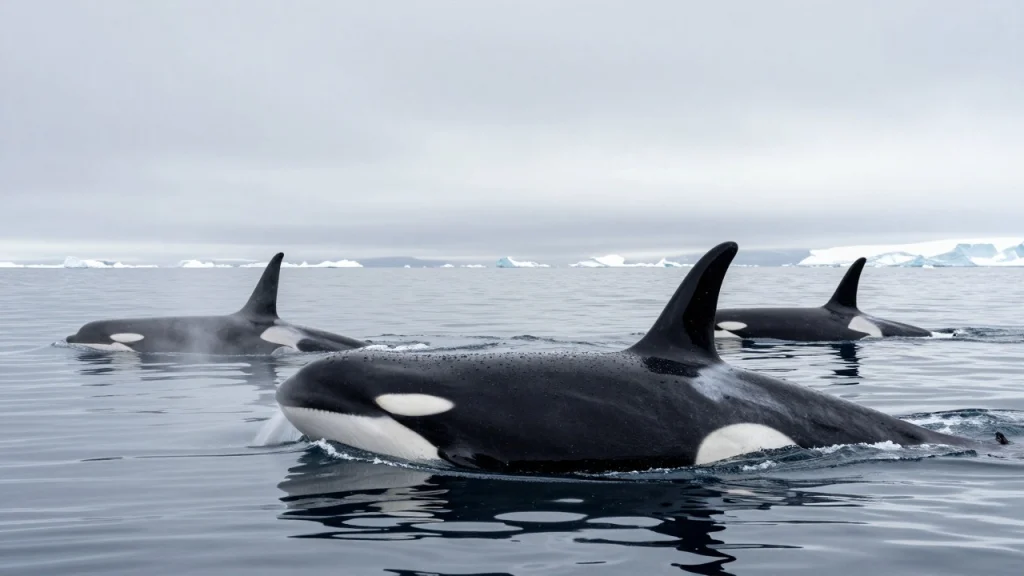
There is no verified record of killer whales killing or eating polar bears, and Animal Diversity Web names just two predators of the polar bear (Ursus maritimus): people, and other polar bears that meet cubs. San Diego Zoo Wildlife Alliance calls polar bears free of natural enemies. The same fact sheet puts them at the top of the Arctic food chain, where they dine mainly on seals. Both animals are apex predators in their own oceans, so what connects them is not predation but leftovers.
What researchers document runs the other way: killer whales kill whales, and polar bears scavenge what is left. A San Diego Zoo Wildlife Alliance fact sheet lists whale carcasses from killer whale predation among the food polar bears take opportunistically, with bowhead whale remains in the Beaufort Sea and in Foxe Basin, Canada, as examples. Whale carcasses from native subsistence harvests sit on that same list.
What orcas actually hunt
Killer whales are generalists with strong local preferences. An average whale eats about 45 kg a day and often considerably more. The species is recorded taking a remarkable range of animals:
- Seals and sea lions
- Smaller whales and dolphins
- Fish, with sharks included
- Squid, octopi and sea turtles
- Sea birds, sea otters and river otters
Cooperation and the top of the food chain
Hunting is social. Orcas work in groups, coordinating behavior and calls so they can take prey larger than themselves. Orcas themselves face no natural predator, though calves and juveniles can fall to other orcas or big sharks, and orcas are the top predator in every region where they occur. Size is not what keeps a bear safe: an adult male orca averages 8 m, with a maximum length of 9.75 m, and carries 7200 kg on average, while most male polar bears weigh 300 to 635 kilograms and the heaviest animal ever recorded topped 1,700 pounds (770 kilograms).
One species, many diets
Populations specialize, and specialists often share the same water. In the northeast Pacific, one ecotype feeds almost entirely on marine mammals while the resident ecotype eats fish. Arctic whales follow the marine mammal version of that pattern: Inuit observers report little specialization in prey beyond marine mammals and no confirmed fish meals in the diet, and where fish eating happens at all, it seems extremely rare. Phocid seals were named by 70% of interviewees, narwhal by 60%, beluga by 52% and bowhead whales by 46%.
Why bears and orcas rarely meet
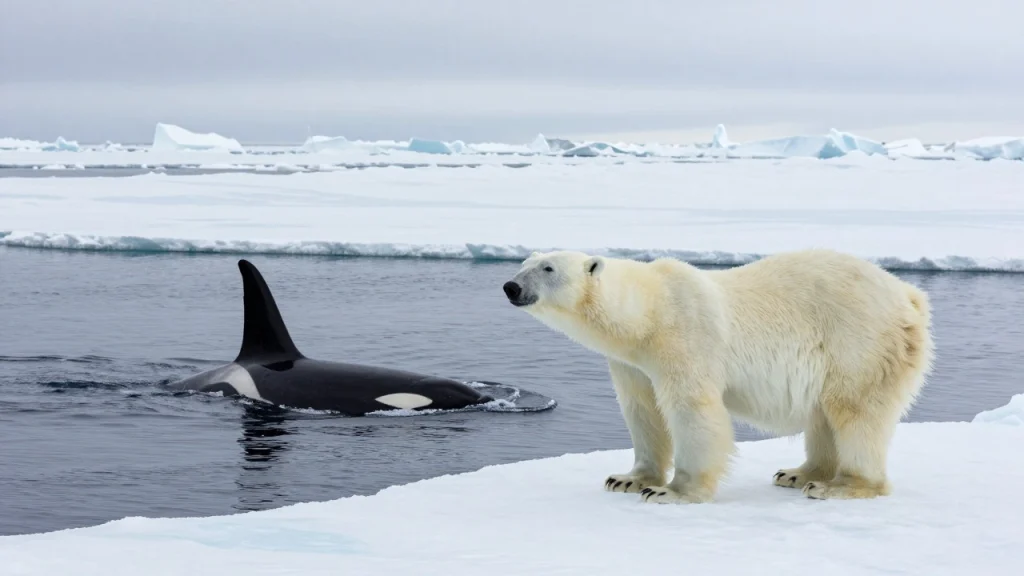
Habitat, not size, keeps the two apart. Killer whales occur worldwide and reach high densities at high latitudes, yet in the Arctic they generally avoid ice. In the eastern Canadian Arctic they arrive with the open water season, from about July to October, and hunt inside bays and inlets. Across the Arctic, polar bears hunt where cracks in the sea ice and breathing holes give them access to seals.
Bears do cross open water, so contact is possible. Polar bears are excellent swimmers that range far for food, with sightings documented as far south as Maine, and one documented swim covered 60 miles (about 100 kilometers) of open water without a rest. With ice shrinking, some now face swims of a few hundred miles, and the effort drains their energy and fat stores.
Ice and shallow water work as refuges. Inuit hunters and elders described ice cover and shallow water as places prey can slip away from killer whales. Tagged narwhals show how fast that works: with no orcas nearby they used open, deep water, and with orcas in the inlet they shifted to shallow, nearshore areas.
The link that is documented: carcasses
Carrion does much of the connecting. Polar bears are carnivores whose primary prey is the ringed seal (Pusa hispida), and the menu also includes carrion from seals, walruses and whales. Inuit hunters occasionally found bowheads that killer whales had killed, and hunters in Foxe Basin estimated bowhead kills there at 3 to 10 a year.
The predation that does reach polar bears comes from their own kind. Males may prey on cubs when they come into contact, and cubs are the animals most often at risk, sometimes adult females, though such killings are thought to occur infrequently.
Melting ice is redrawing the ranges
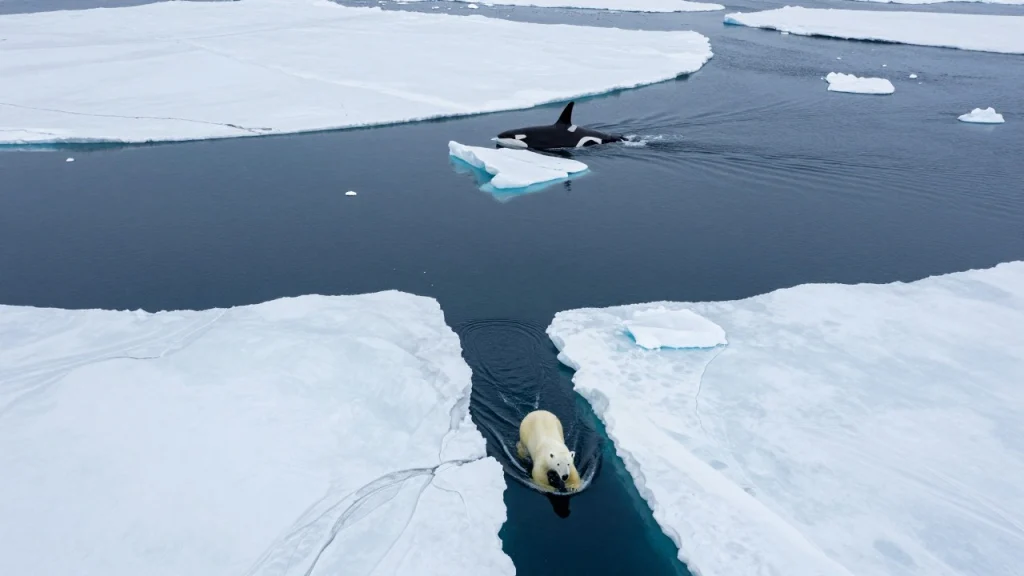
Orcas and polar bears now share more water than they used to. Rising sightings track with shrinking sea ice, both in extent and in season length, and ice that once acted as a barrier now opens passages into stretches where they had rarely or never been seen. Inuit hunters in the eastern Canadian Arctic report more orcas in the area than before.
The overlap is measurable, not theoretical. An estimate for the North Water counted more than 27,000 marine mammals in May, polar bears among them, along with beluga whales, narwhal, walrus and seals. Reviews of Inuit ecological knowledge and sighting records still describe Arctic killer whales as feeding mainly, and possibly only, on marine mammals.
The bears are losing the platform their whole strategy depends on. With less ice, polar bears spend more time on land and turn to alternative foods, and a long-term analysis of western Hudson Bay bears documented a 30% decline in that population from 1987 to 2011.
What a polar bear is built for
The hunting method explains why open water is bad news for a bear. A bear can wait motionless for hours above a breathing hole in the ice, and a single ringed seal carries enough energy for 11 days, yet most bears feed only every four to five days. It is the most common seal around the Arctic. Their sense of smell reaches 20 miles (32 kilometers), enough to find a seal on the ice. Average lifespan runs 20 to 25 years for females and 15 to 18 years for males, and San Diego Zoo Wildlife Alliance lists the species as threatened.
What the evidence adds up to
Killer whales do not have polar bears on their menu, and no reliable record places a bear among orca prey. The documented relationship runs the other way: orcas kill whales, polar bears scavenge the leftovers, and melting ice is putting the two animals in the same water far more often than before. The pressure facing polar bears comes from the loss of sea ice, not from whales hunting bears.
Sources
- Animal Diversity Web: Orcinus orca (killer whale)
- Animal Diversity Web: Ursus maritimus (polar bear)
- San Diego Zoo Wildlife Alliance: Polar Bear
- San Diego Zoo Wildlife Alliance Library: Diet & Feeding – Polar Bear (Ursus maritimus) Fact Sheet
- Fisheries and Oceans Canada: Canada’s Oceans Now: Case Studies from State of Canada’s Arctic Seas Report, 2019
- Polar Biology (via PubMed Central): Prey items and predation behavior of killer whales (Orcinus orca) in Nunavut, Canada based on Inuit hunter interviews