
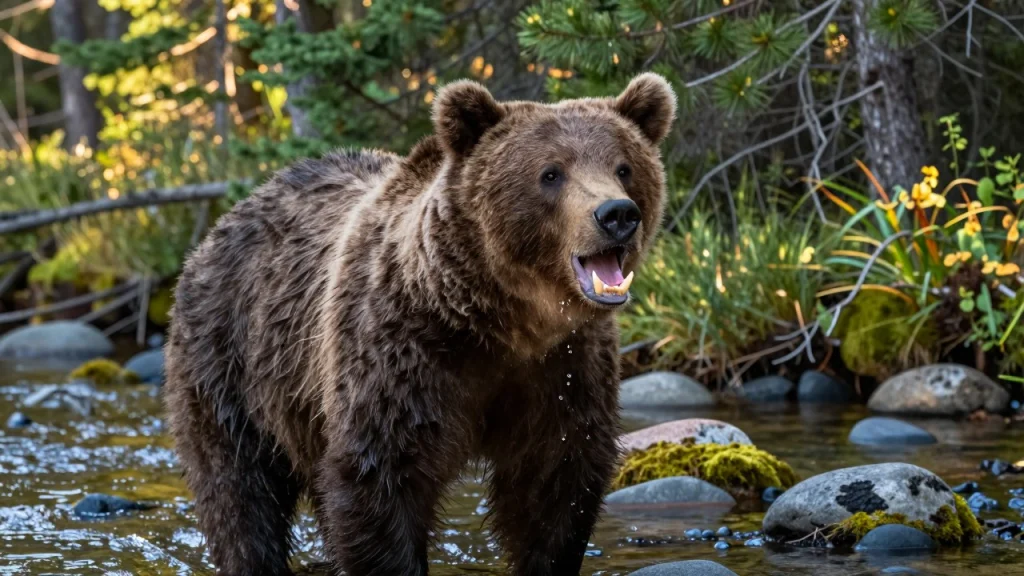
Most adult bears have a dental formula totaling 40 to 42 teeth, full sets of 42 in species such as the Asiatic black bear, suited to handling an omnivorous diet. While species like polar bears rely primarily on meat and panda bears feed almost exclusively on bamboo, the vast majority of bear species, including brown bears and American black bears, possess a versatile set of teeth adapted for grinding plants, tearing meat, and cracking tough vegetation.
Understanding how many teeth an adult bear has and what they are used for offers fascinating insight into how these powerful wild mammals adapt to their environments and secure nourishment across varying seasons.
The structure of a bear’s dental arrangement
An adult bear’s mouth contains four distinct types of teeth, each serving a unique mechanical role during feeding:
- Incisors (12 total): Located at the very front of the upper and lower jaws, these small teeth are primarily used for biting off small vegetation, nipping insects, clipping roots, and grooming fur.
- Canines (4 total): Prominent, deeply rooted, and slightly curved, the four canine teeth (two upper, two lower) act as primary tools for capturing prey, grasping heavy objects, tearing flesh, and defending against threats.
- Premolars (14 to 16 total): Positioned directly behind the canines, premolars assist in holding food and shearing material. The first three are often small and weakly developed, and some are lost as the bear ages.
- Molars (10 total): Found at the back of the mouth, bears have four upper and six lower molars. Unlike the sharp, shearing molars of strict carnivores like lions, bear molars feature broad, flat crowns ideal for crushing and grinding tough plant matter, nuts, and berries.
How bear teeth adapt to an omnivorous diet

Bears belong to the order Carnivora, yet most species operate as opportunistic omnivores. Their dental anatomy reflects this dietary flexibility. The combination of elongated canines and flattened molars allows bears to switch seamlessly between hunting animal prey, scavenging carcasses, and consuming seasonal harvests of fruits, roots, and foliage.
Between the front canines and the rear molars lies a distinct gap known as a diastema. This gap creates room for plant matter and debris to shift while the bear uses its front teeth to clip vegetation or strip bark, preventing raw material from crowding the mouth.
Functional differences across bear species
While the standard dental formula for an adult bear totals 40 to 42 teeth, minor variations in tooth wear, structure, and functional use occur depending on a species’ primary diet:
- Polar bears: Live throughout the Arctic and are highly carnivorous, feeding mainly on ringed seals, unlike the more omnivorous diets of other bear species.
- Giant pandas: Feature enlarged, flattened molars equipped with high ridges to crush dense bamboo stems and fibrous stalks throughout the day.
- Brown and black bears: Maintain classic omnivorous dentition, utilizing their molars extensively during late summer and autumn to process vast quantities of acorns, berries, and vegetation prior to winter dormancy.
Dental wear and wild survival
Because bears consume coarse materials such as soil-covered roots, bones, and hard nut shells, their teeth undergo significant wear throughout their lives. Wildlife biologists often estimate a bear’s age by examining the growth rings within the root of a tooth, much like counting tree rings.
Maintaining functional teeth is critical for survival in the wild. Healthy canines and molars enable adult bears to gather sufficient calories to build up essential fat reserves before entering winter dormancy or rearing young.