
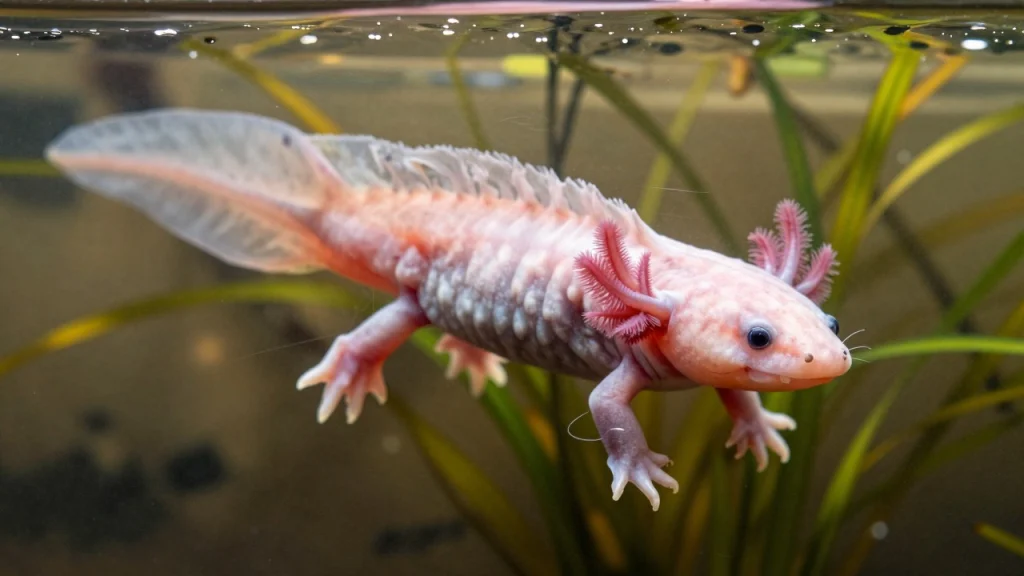
Axolotls can surge at 10 miles per hour when they must escape.
That figure describes a brief emergency dash, not routine travel.
Most hours involve creeping over mud and pausing in cover, with swimming saved for repositioning or flight.
Mature animals typically patrol on foot instead of cruising in midwater, so everyday movement stays unhurried and close to the substrate.
Their build favors tight turns among plants rather than straight line velocity, which explains constant slow motion punctuated by sudden flicks.
For a bottom dwelling salamander, economy beats velocity because food, shelter and mates all sit within the same vegetated patch.
Why burst pace tells only half the story
Burst escape lets a soft bodied salamander break contact with a threat and vanish into weeds.
Axolotls rarely hold speed for long because their anatomy trades sustained thrust for agility.
Researchers describe the design as tuned for weaving through lake growth instead of chasing in open water.
That trade makes ecological sense in still, plant filled habitat where a quick pivot matters more than a long pursuit.
Larvae swim more often than grown animals, yet even young stay near the bottom rather than ranging through the water column.
How axolotls actually move through water
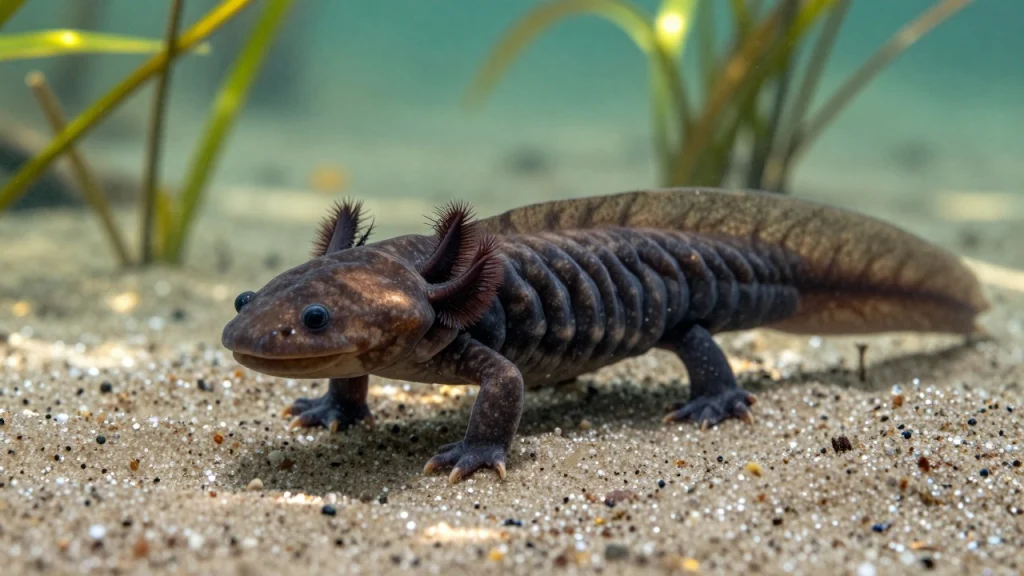
Axolotls employ complementary styles, stepping with small legs and rippling with a flattened tail.
The choice depends on distance, urgency and obstacles, so observers see long pauses broken by short relocations.
Tail powered undulation for short dashes
Eel style undulation drives active swimming, with waves passing along the trunk and tail to push water backward.
Both juveniles and grown individuals bend the whole body from side to side in the same serpentine manner.
A deep, muscular tail supplies most of the thrust during these episodes.
The appendage is strongly developed and laterally flattened, which gives each sweep a broad paddle surface.
In an adult the tail section measures 97 to 120 mm, so it forms a substantial propeller relative to total length.
Animals can reach up to 30 cm in total, which keeps absolute stride short compared with fishes of similar habitat.
Because thrust comes from body waves, acceleration feels abrupt while cruising remains modest.
Strolling, pausing and adjusting float
Bottom walking dominates adult behavior, with the small limbs stepping deliberately across mud, sand or rock.
Wild individuals devote much of the day to resting motionless on lake and canal beds.
Stillness conserves energy and improves camouflage against dark sediment.
From that resting posture they occasionally rise to swallow or vent air, fine tuning how buoyant they feel.
The adjustment helps them hover just above the substrate without constant paddling.
A sensory array along the head and flanks detects nearby water displacement and vibration, so they sense approach without seeing it.
That awareness lets a resting animal decide between freezing and dashing.
Shaped for still lakes and tangled plants
Still water living defines every aspect of axolotl locomotion.
These amphibians occupy calm lakes rather than streams, so they never evolved to fight current.
Their native system historically centered on Lakes Chalco and Xochimilco near Mexico City.
Today the wild range has contracted to 3 separate strongholds around Mexico City, all toward the south.
That contraction concentrates survivors in canals and remnant lakes around the Xochimilco district, a mosaic of urban and rural waterways.
There they use deep basins, human dug channels, rooted plants and soft substrates of mud, sand or gravel.
Vegetation supplies egg attachment points, daytime hiding places and hunting perches.
Preferred water stays cool, with a reported range of 16 to 20 degrees Celsius, which supports a low metabolic pace.
Cool, vegetated shallows reward precise maneuvering because stems and roots block straight sprint lanes.
Patient hunters that lunge, not chase
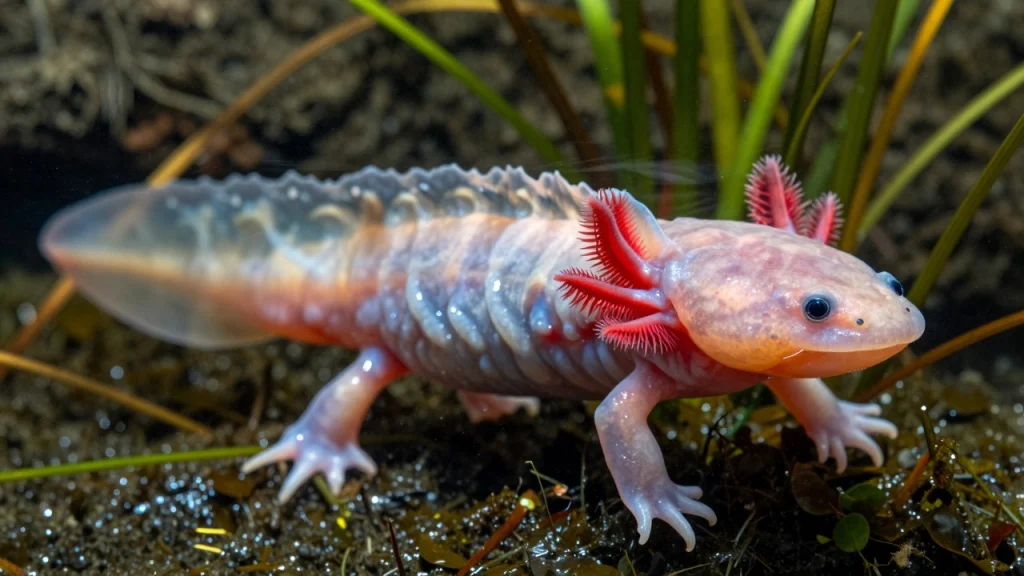
Ambush predation explains why speed is rarely needed for feeding.
Adults wait in cover and then inhale prey with a sudden gulp, rather than running it down.
The diet centers on small aquatic animals that can be overtaken with a sudden lunge.
- worms and insect larvae picked from sediment or plants
- small fishes that stray too close to a hidden snout
- mollusks and small crustaceans crushed after capture
- tadpoles and other bite sized swimmers taken at night
Teeth are tiny and blunt, suited to gripping rather than cutting, so capture depends on vacuum force instead of bite power.
Feeding usually happens after dark, while daylight hours are spent tucked inside weeds and silt to dodge daytime hunters.
Larvae feed lower in the food web on zooplankton and worms and seldom rise high to seize items.
As the dominant small predator in its original community, an axolotl could take almost any catchable animal, including other axolotls.
That opportunism reduces the need for travel because many potential meals drift or crawl within lunging range.
A life cycle tied to water from egg to adult
Permanent aquatic life means swimming skill is needed at every age, but in different proportions.
Unlike most salamanders, axolotls retain larval traits after becoming reproductively mature.
They stay fully water dwelling throughout adulthood instead of shifting to land.
Functional lungs develop, yet feathery external branches remain the principal underwater breathing organ.
Young animals keep the full larval toolkit of external gills, tail fin and fin supported trunk, and they never gain movable eyelids.
Feathered gills plus a finned tail provide both gas exchange and propulsion without leaving the lake.
Lizard like legs carry the body along the bottom once the limbs strengthen, adding walking to the early swimming repertoire.
Hatchlings begin active movement only two weeks after laying, immediately swimming away from the egg site.
There is no guarding parent, so even new larvae must maneuver, hide and feed alone.
Maturity can arrive by about six months, followed by courtship from March through June when conditions turn milder.
A female can produce 300 to 1,000 eggs in a reproductive effort, attaching them singly to plants or stones.
High fecundity offsets heavy losses among slow, small young in canals shared with introduced fishes.
What slow travel means for wild survival
Critically Endangered status reflects habitat pressure more than locomotor limits.
Remaining populations face the combined effects of pollution, habitat degradation, and predation plus competition from non native species.
A slow walker cannot outrun drainage, siltation or dense tilapia and carp introductions.
Dark mottled skin camouflages an animal that relies on stillness, yet it offers little defense when water clears or cover is removed.
Conservation therefore focuses on refuge channels, clean flows and plant beds where short bursts and tight turns still work.
In that restored setting, that dash is enough to slip from a heron shadow or a lunging fish into adjacent stems.
Protecting connected vegetation lets axolotls keep doing what they do best, waiting quietly, walking deliberately and sprinting only when survival demands it.
Sources
- San Diego Zoo Wildlife Alliance: Axolotl | San Diego Zoo Animals & Plants
- San Diego Zoo Wildlife Alliance: Behavior & Ecology – Axolotl (Ambystoma mexicanum) Fact Sheet
- San Diego Zoo Wildlife Alliance: Physical Characteristics – Axolotl (Ambystoma mexicanum) Fact Sheet
- Animal Diversity Web: Ambystoma mexicanum (Salamandra ajolote) Information
- San Diego Zoo Wildlife Alliance: Distribution & Habitat – Axolotl (Ambystoma mexicanum) Fact Sheet